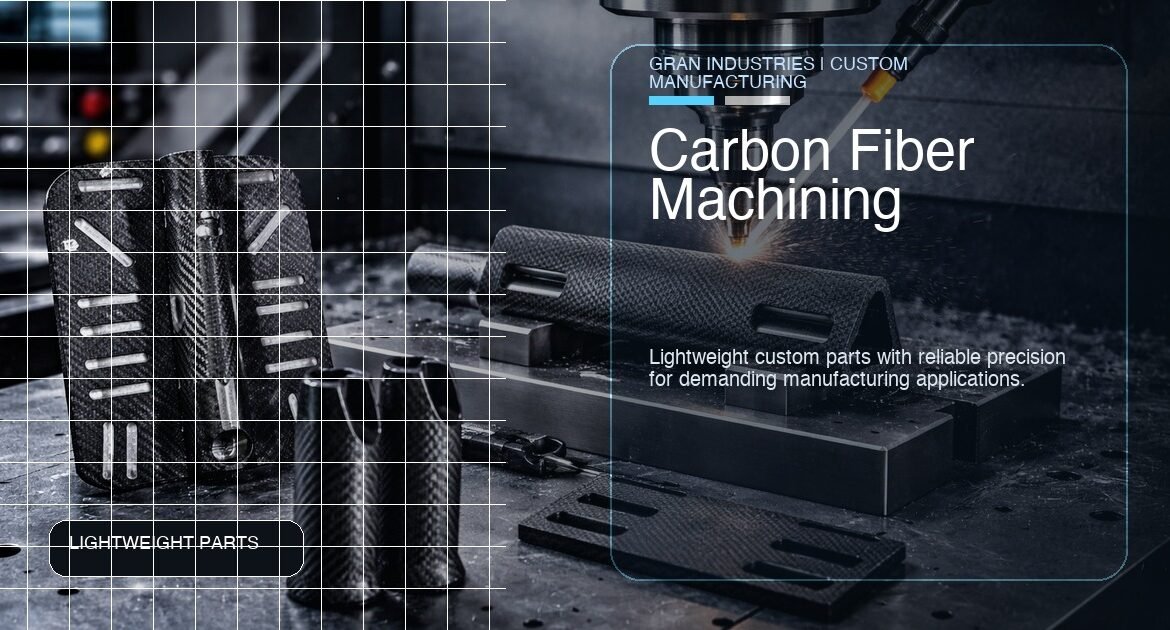
Carbon fiber machining has become an important part of modern custom manufacturing because it supports the production of components that are both lightweight and strong. For projects where weight reduction, part stiffness, and precision all matter, carbon fiber offers practical advantages that are difficult to ignore. When paired with accurate CNC machining, it allows manufacturers to create custom parts that meet specific performance requirements while maintaining consistent quality.
For businesses developing precision components, the value of carbon fiber is not only in the material itself, but also in how effectively it can be processed into finished parts. Machining plays a key role in turning engineered carbon fiber material into usable components for industrial, automotive, and other performance-driven applications.
Why Carbon Fiber Is Well Suited for Custom Parts
One of the main reasons carbon fiber is used in custom part manufacturing is its high strength-to-weight ratio. This makes it especially useful for applications where reducing overall mass can improve handling, efficiency, or structural performance. Compared with heavier traditional materials, carbon fiber can support design goals that require strength without adding unnecessary weight.
Carbon fiber is also valued for its stiffness and dimensional stability. These characteristics help make it a practical choice for parts that must maintain their shape and performance under demanding operating conditions. In custom manufacturing, this allows designers and engineers to pursue applications where precision and material performance must work together.
How CNC Machining Adds Precision to Carbon Fiber Processing
CNC machining helps manufacturers shape carbon fiber components with a controlled and repeatable process. This is especially important for custom parts because they often involve unique dimensions, functional surfaces, and application-specific geometries. CNC machining supports accurate cutting, drilling, trimming, and finishing, helping each part align more closely with its intended design.
For custom projects, precision is important from the first part to the final batch. A controlled machining process helps manufacturers maintain tighter tolerances and better repeatability, which supports both prototype work and production manufacturing. This is one reason carbon fiber machining continues to be relevant for high-value component fabrication.
Supporting Lightweight Performance Across Industries
Lightweight part manufacturing is important in many sectors because lower weight can contribute to better efficiency and improved functional performance. Carbon fiber machining supports this need by making it possible to produce parts that are strong enough for demanding use while remaining lighter than many conventional alternatives.
This is particularly relevant for projects involving high-performance assemblies, structural components, and customized parts where every design choice affects the final result. In these cases, carbon fiber machining is not just a material process; it is part of a broader effort to improve part performance through intelligent manufacturing.
The Importance of Process Control in Carbon Fiber Machining
Although carbon fiber offers many benefits, it also requires careful handling during machining. Process control is important because composite materials can respond differently from metals during cutting and finishing operations. Tool selection, machining strategy, and quality checks all contribute to better results.
For manufacturers, this means carbon fiber machining should be approached with the same level of planning used for other precision manufacturing work. A controlled workflow helps protect part quality, reduce variation, and support cleaner, more consistent finished components.
Why Custom Manufacturing Projects Benefit from Carbon Fiber Expertise
Custom parts are rarely one-size-fits-all. They are usually developed around a specific use case, design requirement, or performance target. Carbon fiber machining supports this kind of work because it gives manufacturers the flexibility to produce specialized components without moving away from precision-focused production methods.
When material knowledge and machining accuracy are combined, manufacturers are better positioned to support projects that require both lightweight construction and dependable fabrication quality. That is why carbon fiber machining remains an important capability in custom part manufacturing.
A Practical Manufacturing Option for High-Performance Components
For companies sourcing custom parts, carbon fiber machining offers a practical path toward lightweight, high-strength component production. It supports precision, helps manufacturers respond to custom requirements, and aligns well with projects where performance and material efficiency are both priorities.
As more businesses look for advanced manufacturing solutions, carbon fiber machining continues to stand out as a reliable way to produce custom parts that balance weight, strength, and manufacturing precision.