Custom Carbon Fiber CNC Machining Services for Lightweight High-Strength Parts: Precision Solutions for Aerospace and Industrial Applications
Carbon fiber CNC machining represents a cutting-edge approach to manufacturing lightweight, high-strength parts that are essential in various industries, particularly aerospace and automotive. This article delves into the intricacies of carbon fiber CNC machining, exploring its processes, benefits, and applications. Readers will gain insights into how this technology enhances the production of complex components while maintaining precision and quality. As industries increasingly demand lightweight materials for improved performance and efficiency, understanding carbon fiber CNC machining becomes crucial. We will cover the definition and mechanisms of this technology, its key benefits, the industries that rely on it, common challenges, and the importance of quality assurance in the machining process.
What is Carbon Fiber CNC Machining and How Does It Enhance Lightweight High-Strength Part Production?
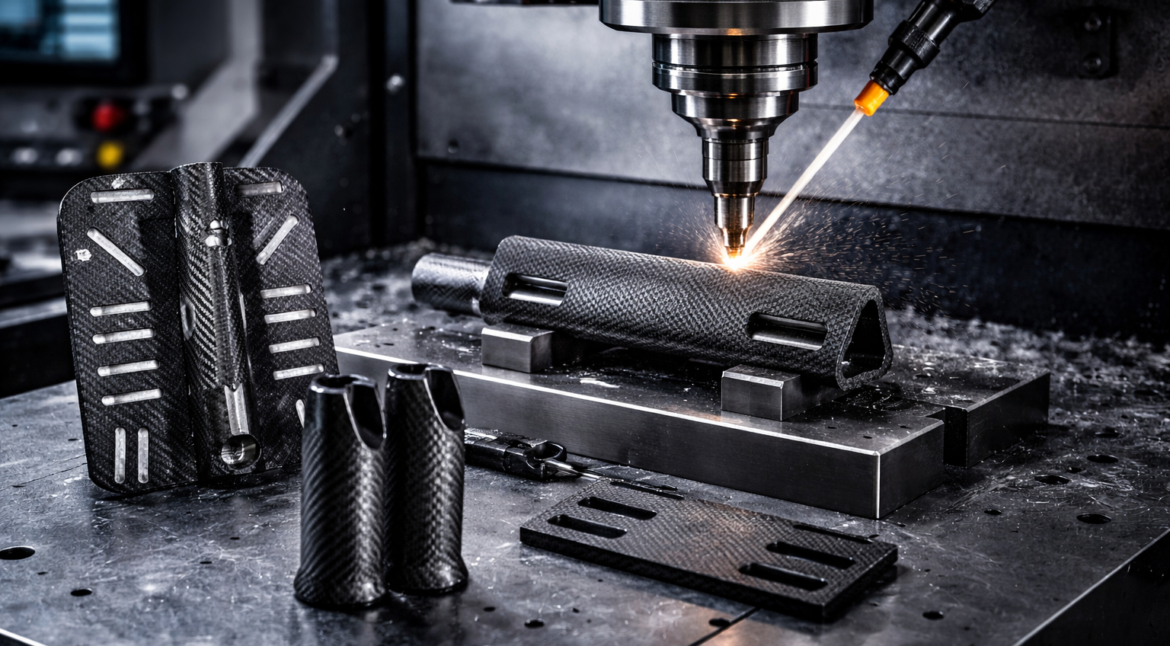
Carbon fiber CNC machining is a specialized manufacturing process that utilizes computer numerical control (CNC) technology to fabricate parts from carbon fiber reinforced polymer (CFRP) materials. This method enhances the production of lightweight, high-strength components by allowing for precise cutting, shaping, and finishing of complex geometries. The integration of CNC technology ensures that parts are produced with high accuracy and repeatability, which is essential for applications where performance and reliability are critical.
Understanding CNC Machining Processes for Carbon Fiber and CFRP Materials
CNC machining processes for carbon fiber and CFRP materials involve several key techniques, including milling, turning, and drilling. These processes leverage the unique properties of carbon fiber, such as its high strength-to-weight ratio and stiffness. The use of specialized cutting tools designed for composite materials minimizes the risk of damage during machining, ensuring that the integrity of the carbon fiber is maintained. Additionally, CNC machines can be programmed to execute complex designs that would be challenging to achieve with traditional manufacturing methods.
How 3-Axis and 5-Axis CNC Machines Enable Complex Carbon Fiber Part Fabrication
3-axis and 5-axis CNC machines play a pivotal role in the fabrication of complex carbon fiber parts. While 3-axis machines operate along three linear axes, 5-axis machines add rotational capabilities, allowing for more intricate designs and shapes. This flexibility enables manufacturers to create components with complex geometries, such as those found in aerospace applications, where aerodynamic efficiency is paramount. The precision offered by these machines ensures that parts meet stringent specifications, reducing the need for extensive post-processing.
This precision is further enhanced by ongoing research into optimizing 5-axis tool positioning for superior surface quality and defect reduction in CFRP materials.
5-Axis CNC Optimization for CFRP Surface Quality & Defect Reduction
Carbon fiber-reinforced plastic/polymer (CFRP) is a composite material widely used in industries such as aerospace, medical equipment, and sport products. The angle between the cutting and fiber orientations significantly impacts surface quality during the machining process due to CFRP’s pronounced anisotropy. This paper introduces a novel tool positioning method for machining CFRP curved surfaces, which considers fiber orientation. This strategy ensures an acute angle between the cutting and fiber orientations at any position, thereby enhancing machining quality. Microscopic observation and surface roughness tests reveal a 52% reduction in surface roughness of CFRP specimens, with most machining-induced cracks eliminated.
Optimizing 5-axis tool positioning and orientation for machining CFRP curved surfaces: considering fibers’ orientation, 2023
What Are the Key Benefits of Precision Carbon Fiber Parts Manufacturing?
The manufacturing of precision carbon fiber parts offers several significant benefits that enhance performance across various applications. These advantages include lightweight and high-strength properties, dimensional stability, and corrosion resistance, making carbon fiber an ideal choice for demanding environments.
- Lightweight and High-Strength Properties: Carbon fiber parts are significantly lighter than traditional materials like aluminum and steel, while also providing superior strength. This characteristic is particularly beneficial in aerospace and automotive industries, where reducing weight can lead to improved fuel efficiency and performance.
- Dimensional Stability: Carbon fiber exhibits minimal thermal expansion, ensuring that parts maintain their shape and dimensions under varying temperature conditions. This stability is crucial for applications requiring precise tolerances, such as in aerospace components.
- Corrosion Resistance: Carbon fiber is inherently resistant to corrosion, making it suitable for use in harsh environments. This property extends the lifespan of components and reduces maintenance costs, providing long-term value to manufacturers.
For businesses looking to leverage these benefits, expert carbon fiber CNC machining services can provide tailored solutions that meet specific project requirements.
Which Industries Rely on Aerospace Carbon Fiber Machining Services and Lightweight CFRP Components?
A variety of industries depend on carbon fiber CNC machining services to produce lightweight CFRP components. These industries include aerospace, automotive, and drone manufacturing, each benefiting from the unique properties of carbon fiber.
How Carbon Fiber CNC Machining Supports Aerospace, Automotive, and Drone Manufacturing
In the aerospace sector, carbon fiber components are used in aircraft structures, interior fittings, and engine parts, where weight reduction is critical for fuel efficiency. The automotive industry utilizes carbon fiber for high-performance vehicles, enhancing speed and agility while maintaining safety standards. Additionally, drone manufacturers rely on carbon fiber for lightweight frames that improve flight performance and battery efficiency.
What Are Emerging Applications for High-Strength Carbon Fiber Prototyping?
Emerging applications for carbon fiber prototyping include the development of custom tooling, sports equipment, and medical devices. As technology advances, the versatility of carbon fiber continues to expand, allowing for innovative designs that were previously unattainable. The ability to rapidly prototype using carbon fiber also accelerates product development cycles, enabling companies to bring new products to market faster.
What Are the Common Challenges in Carbon Fiber CNC Machining and How Are They Overcome?
While carbon fiber CNC machining offers numerous advantages, it also presents challenges that manufacturers must address to ensure quality and efficiency. Common issues include delamination, tool wear, and achieving optimal surface finishes.
How to Prevent Delamination and Manage Tool Wear in Carbon Fiber Machining
Delamination can occur during machining if the cutting process is not carefully controlled. To prevent this, manufacturers can employ specialized cutting tools and techniques that minimize stress on the material. Additionally, regular maintenance of CNC machines helps manage tool wear, ensuring consistent performance and reducing the risk of defects in the final product.
Further research and optimization efforts are continuously being made to address challenges like delamination, particularly through the careful selection and control of machining parameters.
Optimizing CFRP Drilling Parameters for Delamination Control
PurposeThis paper aims to attempt to use grey relational analysis (GRA) coupled with Taguchi technique for the optimization of machining parameters (cutting speed, feed rate and drill bit type) with multiple performance characteristics of delamination
Investigation and optimization of machining parameters in drilling of carbon fiber reinforced polymer (CFRP) composites, 2017
Which Specialized Tools and Techniques Optimize Surface Finish and Thermal Control?
Optimizing surface finish and thermal control in carbon fiber machining requires the use of advanced tooling and cooling techniques. Specialized diamond-coated tools can enhance surface quality, while effective cooling systems prevent overheating during machining. These strategies not only improve the aesthetic quality of the parts but also contribute to their overall performance and longevity.
How Does the Carbon Fiber Machining Process Ensure Quality and Precision in Custom Fabrication?
Quality assurance is a critical aspect of the carbon fiber machining process, ensuring that each component meets the required specifications and standards. The process involves several key steps, from material handling to final inspection.
What Are the Steps from Material Handling to Final Inspection in CNC Machining?
The carbon fiber machining process begins with careful material selection and handling to prevent contamination and damage. Once the material is prepared, CNC machines are programmed to execute precise cuts and shapes. After machining, parts undergo rigorous inspection to verify dimensions and surface quality, ensuring that they meet the necessary standards for performance and safety.
How Do CAD/CAM Software and Advanced Tooling Enhance Machining Accuracy?
The integration of CAD/CAM software in the machining process significantly enhances accuracy and efficiency. These software solutions allow for precise design and simulation of machining operations, reducing the likelihood of errors. Advanced tooling technologies further improve machining outcomes by providing better control over cutting parameters, resulting in high-quality finished products.
Why Choose Expert Custom Carbon Fiber CNC Machining Services for Your Lightweight High-Strength Parts?
Choosing expert custom carbon fiber CNC machining services can provide significant advantages for businesses looking to produce high-quality components. These services offer specialized knowledge, advanced technology, and a commitment to quality that can enhance project outcomes.
What Unique Value Propositions Differentiate Leading Carbon Fiber Machining Providers?
Leading carbon fiber machining providers distinguish themselves through their expertise in material properties, advanced machining techniques, and customer service excellence. They often employ state-of-the-art equipment and maintain strict quality control measures to ensure that every part meets the highest standards.
How Do Case Studies Demonstrate Success in Complex Carbon Fiber Part Manufacturing?
Case studies of successful projects highlight the capabilities of expert carbon fiber machining services. For instance, a recent project involved the production of complex aerospace components that required precise tolerances and lightweight characteristics. The successful delivery of these parts not only met the client’s specifications but also demonstrated the provider’s ability to handle challenging designs and tight deadlines.
Different carbon fiber machining providers offer unique advantages that can significantly impact project success.
| Provider | Specialization | Key Advantage |
|---|---|---|
| Provider A | Aerospace Components | Expertise in lightweight structures |
| Provider B | Automotive Parts | Advanced tooling for precision |
| Provider C | Drone Manufacturing | Rapid prototyping capabilities |
This comparison illustrates how selecting the right machining provider can enhance the quality and efficiency of carbon fiber part production, ultimately leading to better performance in end applications.