Tolerance planning is one of the clearest factors that shapes CNC machining cost and production risk. In custom part manufacturing, a tight tolerance can be necessary when a feature controls fit, sealing, alignment, or motion. But when the same level of precision is applied too broadly, the result is often longer machining time, more inspection effort, and a quotation that no longer reflects only the shape of the part. It reflects the level of control required to make that part repeatedly.
For that reason, tolerance decisions should be part of the manufacturing discussion before machining starts. A drawing may show a fully dimensioned component, but the real production question is which dimensions truly need closer control and which features can follow standard machining capability. The answer affects process planning from setup through final inspection.
What tight tolerances mean in CNC machining
In CNC machining, tolerance defines the permitted variation on a dimension, location, or geometric relationship. A tighter tolerance means the acceptable range is smaller, so the machining process and inspection method need stronger control.
This does not automatically make a part difficult to manufacture. The issue is where the tight control is applied and why. If the tolerance is tied to function, such as a bearing fit, alignment face, sealing diameter, or mating hole pattern, the extra effort may be fully justified. If the same requirement is applied to non-critical features, it can add process burden without improving part performance.
Why tighter tolerances usually increase machining cost
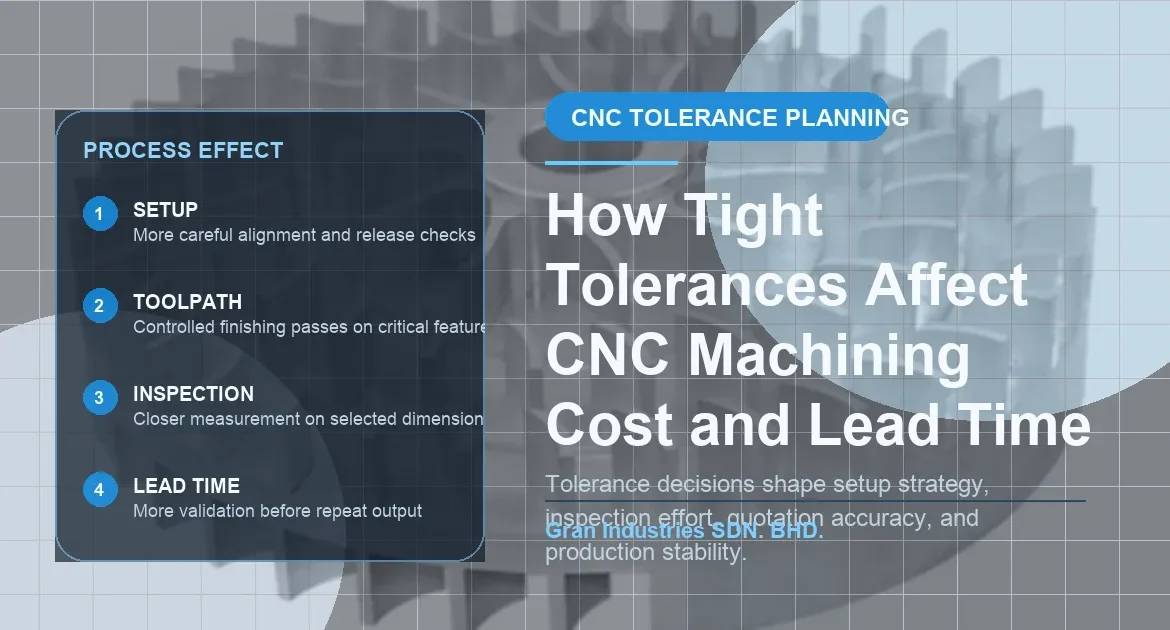
When a drawing calls for tighter control, the machine shop often needs to slow down decision-making across the process, not just the cutting speed. More time may be required for setup validation, tooling selection, fixture stability checks, in-process measurement, and final inspection documentation.
Cost can increase because tighter tolerances often require:
- More careful setup alignment before cutting begins
- Additional passes to approach the final size more gradually
- Closer tool wear monitoring during the machining cycle
- More inspection points during and after production
- Higher scrap or rework sensitivity if a feature drifts out of range
- Greater process discipline when the order moves into repeat batches
That is why tolerance planning connects directly to quotation review. As discussed in our article on drawing review before CNC machining quotes and production, the quote becomes more reliable when critical dimensions are identified clearly instead of assumed.
How tolerance requirements affect lead time
Lead time is influenced by more than machine availability. Tight-tolerance work may require slower setup release, more detailed first-part verification, and longer inspection handling before the order can move forward confidently.
In practice, lead time may be affected by:
- Extra setup checks before the first part is approved
- Longer cycle time on features that need controlled finishing passes
- Additional in-process measurement between operations
- Inspection queue time if more dimensions require verification
- Greater caution before the job is released into repeat production
This is one reason first article review matters. A controlled first-part check helps confirm whether the process can hold the intended dimensions before the full order continues. That relationship is explained further in our article on first article inspection in CNC machining quality control.
What changes on the shop floor when tolerances get tighter
Tight tolerances are not only a drawing issue. They change how the part is manufactured. Even when the geometry stays the same, the process route may need to become more disciplined.
1. Setup strategy becomes more important
If several critical dimensions depend on the same datum relationship, the setup method has to protect that relationship consistently. Workholding, clamping force, and part orientation become more important because small movement can affect the final result.
2. Tooling and sequence may need adjustment
Some features cannot be finished reliably in the same way when closer control is required. The machining sequence may need roughing and finishing separation, additional support features, or revised cutting conditions to reduce deflection and improve repeatability.
3. Inspection effort increases
Once tighter control is specified, the inspection plan becomes more selective and more detailed. Critical dimensions may need dedicated measurement steps, recorded checks, or repeat verification through the run. This is part of why quality control in CNC machining should be treated as part of process planning, not only final acceptance.
When tight tolerances are worth specifying
Tight tolerances are valuable when they protect real function. Common examples include:
- Mating features that determine assembly fit
- Sealing surfaces or fluid-related interfaces
- Bearing locations, bores, or shaft-related dimensions
- Hole patterns that affect fastener alignment
- Datum relationships that control downstream assembly accuracy
- Features linked to customer-defined inspection or validation requirements
In these situations, tighter tolerance is not just a manufacturing preference. It is part of how the part is expected to perform.
When a broader tolerance may be the better decision
Not every edge, outside profile, or non-functional surface needs the same level of control. If a feature does not affect fit, sealing, movement, or appearance in a meaningful way, a broader tolerance may help reduce cost and simplify manufacturing without changing part performance.
This is especially important in prototype and custom-part sourcing, where over-constraining the drawing can slow development unnecessarily. A part can still be precise without applying the tightest tolerance to every dimension.
How customers can specify tolerances more effectively
The best drawing packages usually distinguish between critical features and general features. This helps the machining supplier build a process that matches function instead of treating the whole part as equally sensitive.
Helpful practices include:
- Identifying which dimensions are critical to fit or assembly
- Providing clear datum structure when feature relationships matter
- Separating cosmetic expectations from functional tolerance needs
- Sharing assembly context if the part interfaces with another component
- Confirming whether inspection records are required on selected features
- Discussing prototype intent versus repeat-production intent early
These inputs help the shop make better decisions before quotation is finalized and reduce the chance that the inspection plan becomes either too weak or unnecessarily heavy.
Tolerance planning as part of reliable custom manufacturing
In CNC machining, tight tolerances can support better part performance, but they also affect cost, lead time, and inspection planning. The practical goal is not to make every dimension tighter. The goal is to apply tighter control where the part truly needs it and keep the rest of the drawing aligned with realistic manufacturing requirements.
For custom components, that usually leads to a better result: a part that is easier to quote accurately, easier to inspect correctly, and easier to scale from prototype into repeat production. If you are planning a custom machined part, you can also review our overview of CNC machining services in precision manufacturing or contact Gran Industries to discuss material, tolerance, and inspection requirements before production starts.