CNC加工部品用ステンレス鋼種の選び方

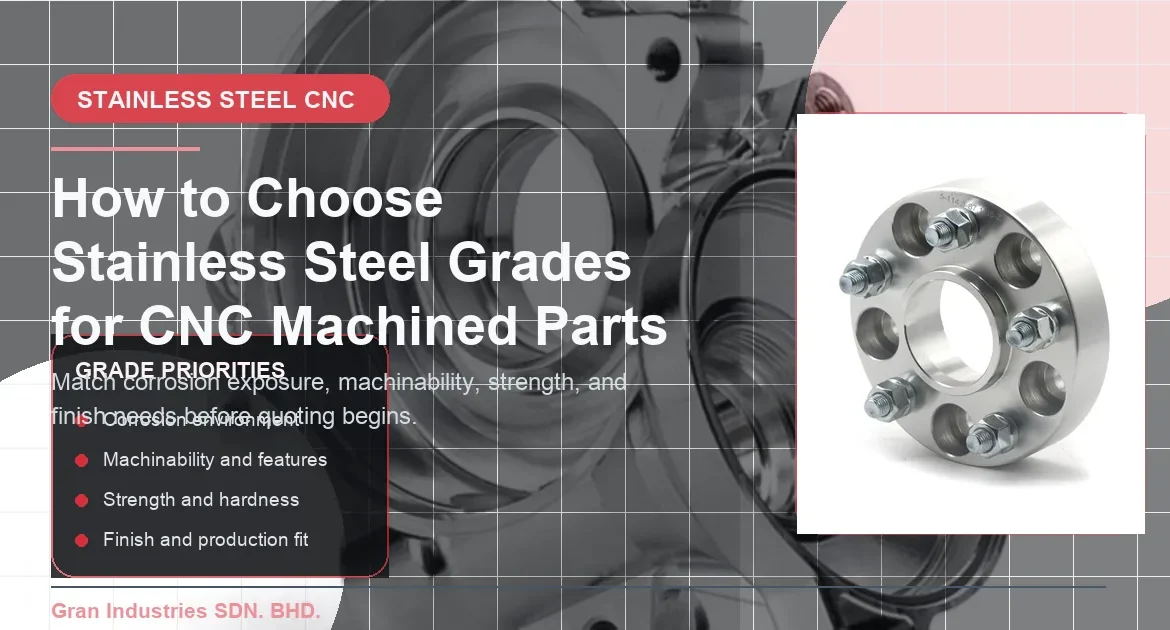
Stainless steel is one of the most common material families used for custom CNC machined parts, but it is rarely enough to specify only “stainless steel” on a drawing or RFQ. Different grades behave differently in corrosion exposure, machining stability, strength level, heat treatment condition, and final surface appearance. A grade that works well for one shaft, fitting, housing, or fastener-related component may not be the right choice for another.

That is why stainless selection should be reviewed as part of the manufacturing discussion before quotation and production begin. The practical goal is not to recommend the most expensive or most specialized grade by default. It is to match the material to the part’s working environment, machining features, and production intent so the result stays realistic for both performance and process control.

At Gran Industries, this type of review is part of the broader discussion around drawing clarity, tolerance priorities, surface expectations, and material fit. When the application is understood early, it becomes easier to recommend a stainless grade that supports the job without creating avoidable cost, lead-time pressure, or production difficulty.

Why stainless steel grade selection matters before machining starts

Stainless steel grades can look similar at a high level, yet they affect machining and end-use performance in different ways. The chosen grade may influence:

  • How easily the part can be milled, turned, drilled, or threaded
  • Whether the component is better suited for wet, chemical, or outdoor environments
  • How the part responds when strength, hardness, or wear resistance matters
  • Whether cosmetic finish requirements are practical after machining
  • How stable the material choice will be from prototype samples to repeat production
  • What inspection and acceptance points need closer attention

これが理由のひとつである。 見積り前の図面審査 is so important. If the grade is left open, the supplier may have to estimate cost and process based on assumptions that do not fully match the real use condition of the part.

Key questions to answer when choosing a stainless grade

In many projects, the best stainless direction becomes clearer when a few practical questions are answered first.

1. How much corrosion resistance does the application really need?

Not every custom part sees the same exposure. Some components work in indoor industrial equipment with only limited moisture contact. Others may face washdown conditions, humidity, outdoor use, or regular contact with fluids and cleaning agents. The more clearly the service environment is described, the easier it becomes to decide whether a general-purpose stainless grade is enough or whether stronger corrosion resistance should be prioritized.

2. Is machinability a major concern for the geometry?

Some parts are simple turned shapes or moderate milling jobs. Others include deep drilling, multiple threads, fine details, thin walls, or larger production quantities where machining efficiency matters more. In those cases, the grade should be reviewed not only for end-use performance but also for how practical it is to machine consistently.

This connects directly to how 厳しい公差は加工コストとリードタイムに影響する. A stainless grade that is harder to machine may still be the right choice, but the tradeoff should be intentional.

3. Does the part need higher strength or hardness?

Some stainless components are mainly selected for corrosion resistance and general durability. Others must also support wear, load, or a higher strength requirement. If the part includes contact surfaces, mechanical loading, or a more demanding service condition, the grade decision should reflect that instead of assuming that all stainless materials perform in the same way.

4. Will the part have visible or finish-sensitive surfaces?

Surface appearance matters more on some stainless parts than on others. Exterior components, visible housings, fittings, or customer-facing details may need more finish planning than purely internal functional parts. If finish quality or post-processing matters, that should be reviewed together with the grade choice.

That is why this topic often overlaps with surface finish planning for CNC machined parts. Material and finish expectations need to support each other.

5. Is the project still in prototype stage or already moving toward repeat production?

Prototype parts are often used to confirm assembly fit, corrosion suitability, or mechanical behavior before the full production plan is fixed. In that stage, it can be useful to compare one stainless direction against another if the application is still evolving. For repeat orders, however, the chosen grade should already support stable sourcing and process planning.

This is closely related to the broader decision between prototype and production CNC machining. A grade that is acceptable for sample validation should still be reviewed against long-term manufacturing practicality.

Common stainless steel directions for CNC machined parts

Different applications call for different stainless grades, but several material directions appear often in machined industrial parts.

303-type stainless for easier machining

When a project places strong emphasis on machinability, a free-machining stainless grade is often considered first. This type of material can be a practical choice for fittings, shafts, threaded parts, bushings, and other components where efficient machining and clean feature generation matter. The tradeoff is that the grade should still be reviewed against the actual corrosion environment rather than selected only because it machines more easily.

304-type stainless for general-purpose corrosion resistance

For many custom parts, a general-purpose austenitic stainless direction is a common starting point. It is often considered for housings, brackets, covers, machine parts, and custom OEM components that need a balanced combination of corrosion resistance, durability, and broad application fit. When the service condition is not unusually aggressive, this type of grade is often the practical baseline for review.

316-type stainless for more demanding exposure

When the part is expected to face stronger moisture-related, chemical, or marine-adjacent exposure, a higher-corrosion-resistance stainless grade may be justified. In those cases, the grade decision should be tied to the real operating environment, not only to the idea that a higher grade must always be better. If the exposure does not require it, the added material and machining cost may not create meaningful value.

Martensitic or precipitation-hardening stainless for strength-focused parts

Some custom components need more emphasis on hardness, wear resistance, or mechanical strength than standard corrosion-focused grades normally provide. For shafts, mechanical elements, fastening-related details, or other performance-driven parts, a harder stainless family may be reviewed. In these cases, the drawing, heat-treatment condition, finish requirement, and actual working load all need to be considered together.

The practical point is not to choose grades by reputation alone. It is to choose the grade that fits the environment, geometry, and production goal of the part.

How part geometry changes the best stainless choice

Material selection should always be reviewed together with part shape. A stainless grade that is workable for a simple flange or spacer may be less efficient for a highly threaded component, a thin-walled housing, or a detail with tight internal features.

Geometry review should usually cover:

  • Turned diameters, grooves, shoulders, and thread features
  • Milled pockets, slots, and flatness-sensitive faces
  • Deep holes, cross-drilling, and tool-access limitations
  • Wall thickness and the stability of long unsupported features
  • Critical fits, sealing surfaces, or wear-related contact areas

That is why stainless material choice often connects directly to stainless steel CNC machining service planning. The material and the process route need to support each other if the result is going to be stable in production.

Why finish and inspection still matter with stainless parts

Stainless steel is often chosen for durability and appearance, which means finish and inspection should not be treated as secondary issues. A part can be dimensionally acceptable but still create problems if the visible faces, sealing features, or contact surfaces are not reviewed closely enough.

これが理由のひとつである。 CNC加工における品質管理 is relevant to stainless work as much as to any other material. Inspection planning should reflect the actual function of the part, including fit, cosmetic condition, and any finish-sensitive zones that matter in assembly or use.

What to send when requesting a quote for stainless steel CNC parts

A better quote request usually produces a better material recommendation. For stainless parts, useful inputs often include:

  • 2D drawing and 3D file when available
  • The intended working environment, including moisture, chemicals, or outdoor exposure
  • Any preferred grade already under consideration
  • Critical dimensions, threads, sealing faces, or cosmetic surfaces
  • Expected quantity for prototype and repeat production
  • Whether heat treatment, passivation, polishing, or another follow-up step is required
  • Assembly notes that explain how the part functions with surrounding components

When that information is clear, quotation becomes more useful because the material discussion can focus on real application needs instead of assumptions.

Choosing the right stainless grade for the job

The best stainless steel grade for a CNC machined part depends on what the part needs to do in actual service. Corrosion exposure, machinability, strength level, finish expectations, geometry, and production stage all matter. A grade that performs well in one project may be unnecessary or inefficient in another if the environment and process demands are different.

For custom stainless parts, the stronger approach is to review material choice together with the drawing, tolerance priorities, finish expectations, and order quantity before production starts. That makes it easier to move toward a more dependable machining plan and avoid unnecessary revisions later.

If you are sourcing custom stainless steel shafts, fittings, housings, brackets, or precision OEM components, Gran Industries can review the drawing, quantity, and application condition before quotation. You can also explore our stainless steel CNC machining service page for related capability context, or 部品詳細を送信してください。 準備ができたら.