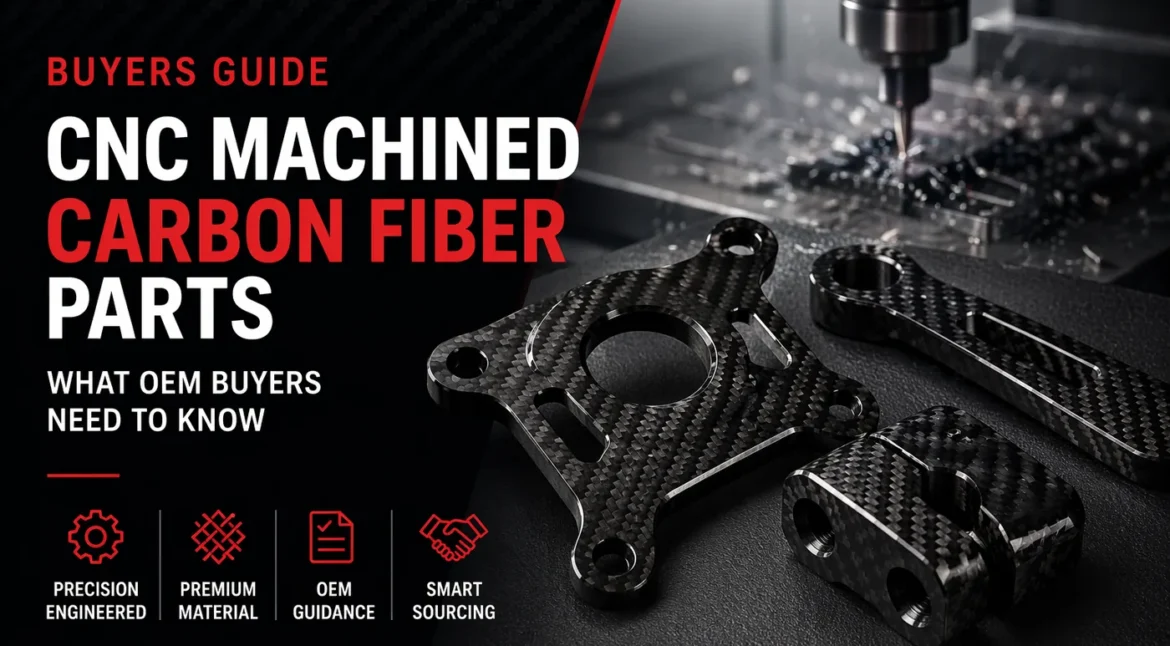
Carbon fiber has become the material of choice across industries where weight savings and structural rigidity cannot be compromised. From aerospace brackets to UAV frames, motorsport components to high-end consumer electronics, demand for precision CNC machined carbon fiber parts continues to grow as engineers push the boundaries of product performance.
But carbon fiber composite is not a forgiving material. It behaves nothing like aluminum or steel under a cutting tool. Understanding its machining characteristics — and choosing the right manufacturing partner — can mean the difference between dimensionally accurate, delamination-free parts and costly, unusable scrap.
This guide is written for OEM engineers and procurement managers who need to source custom CNC machined carbon fiber components. We cover material selection, machining process considerations, tolerances, surface finishing, and what to look for when qualifying a supplier.
What Makes Carbon Fiber Difficult to Machine?
Carbon fiber reinforced polymer (CFRP) presents unique challenges that require specialized tooling, cutting parameters, and operator experience.
Abrasive Nature of Carbon Fiber
Carbon fiber is extremely abrasive — significantly more so than aluminum or titanium. Standard high-speed steel tooling wears rapidly and is effectively unusable for CFRP. Solid carbide tooling is the minimum requirement, with diamond-coated or PCD (polycrystalline diamond) tools preferred for production runs.
For OEM buyers, this is critical: a supplier using incorrect tooling will produce parts with ragged edges, fiber pullout, and accelerated surface degradation.
Delamination Risk
CFRP is a layered composite material. If cutting forces are too high, the resin binding layers can fail — causing catastrophic delamination that separates the fiber layers. This type of defect is often invisible externally but catastrophically weakens the part.
Preventing delamination requires:
- Controlled cutting speeds and feeds specific to CFRP
- Sharp tooling replaced at appropriate intervals
- Proper clamping to minimize vibration
- Backing plates at drill exit points
Dust and Health Hazards
Carbon fiber machining produces fine particulate that is a respiratory hazard and can cause electronic equipment to short circuit. Professional CFRP machining requires enclosed machining environments with HEPA filtration and full PPE for operators — another important qualification criterion when assessing suppliers.
Common Carbon Fiber Grades for CNC Machining
Not all carbon fiber composite sheets and tubes are the same. OEM buyers should specify the correct prepreg type and fiber orientation for their application.
Standard Modulus CFRP (Woven 3K / 12K)
Typical Specification: 3K plain weave or twill weave prepreg, 0.5mm–10mm thickness
Mechanical Properties:
- Tensile Strength: ~600 MPa
- Flexural Modulus: ~70 GPa
- Density: 1.5–1.6 g/cm³
Best for: Drone frames, motorsport body panels, lightweight structural brackets, consumer electronics enclosures
Standard modulus woven CFRP is the most widely available material and offers excellent machinability relative to higher-modulus grades. The visible woven texture is also highly desirable for aesthetic parts.
Unidirectional CFRP (UD Layup)
Typical Specification: UD prepreg layup, custom ply orientation per customer engineering drawings
Mechanical Properties:
- Tensile Strength: ~1,200–1,800 MPa (along fiber direction)
- Highly anisotropic — weak perpendicular to fiber direction
Best for: Structural beams, load-bearing chassis components, aerospace primary structure
UD CFRP achieves significantly higher strength than woven material in one direction but requires careful layup design. CNC machining of UD parts requires experienced operators to manage the strongly directional fiber structure.
Carbon Fiber + Aluminum Sandwich Panels
Hybrid construction bonding CFRP face sheets to an aluminum honeycomb core delivers exceptional stiffness-to-weight ratios for large flat panels. These are common in aircraft interiors, high-performance racing components, and satellite structures.
CNC Machining Processes for Carbon Fiber Parts
Gran.myでは carbon fiber processing service covers the full range of CFRP machining operations:
ミーリング
3-axis and 5-axis CNC milling is used to produce complex profiles, pockets, and contoured surfaces in CFRP sheet stock. With proper diamond-coated tooling and carefully controlled feed rates, we achieve clean, delamination-free cuts with surface roughness of Ra 0.8–1.6 μm on machined faces.
Key parameters:
- Spindle speed: 18,000–24,000 RPM
- Feed rate: adjusted per material thickness and fiber orientation
- Climb milling preferred to reduce delamination risk
Drilling and Counterboring
Precision drilling in CFRP is among the most technically demanding operations. Hole exit delamination is the most common failure mode in CFRP drilling.
Our process uses:
- Diamond-coated Brad-point drill geometry
- Backing plates at all drill exits
- Peck drilling cycles for deep holes
- Hole diameter tolerance: ±0.05mm standard, ±0.02mm available upon request
ウォータージェット切断
For complex 2D profiles in sheet material, CNC waterjet cutting avoids the heat generation and edge delamination risk of rotary cutting tools. Waterjet is ideal for large-format panels where milling cycle time would be prohibitive.
Limitation: Waterjet cannot produce tight dimensional tolerances on holes or complex 3D features. It is best suited for profile cutting, with machined features added in a subsequent CNC milling operation.
CNC Routing
High-speed CNC routing is used for trimming, edge finishing, and producing slots or cutouts in CFRP sheet components. The process requires vacuum fixturing to prevent part movement during cutting.
Tolerances and Quality Standards
OEM engineers need to know what dimensional accuracy is achievable when specifying carbon fiber parts.
| Feature Type | Standard Tolerance | Tight Tolerance (on request) |
|---|---|---|
| External profile | ±0.15 mm | ±0.05 mm |
| Hole diameter | ±0.05 mm | ±0.02 mm |
| Hole position | ±0.10 mm | ±0.03 mm |
| Flatness (per 100mm) | 0.2 mm | 0.1 mm |
| Edge surface roughness (Ra) | 1.6 μm | 0.8 μm |
All parts are inspected using digital calipers and CMM (coordinate measuring machine) verification on critical dimensions. Material certifications are available upon request.
Surface Finishing Options for Carbon Fiber
CFRP can be supplied with a range of surface finishes depending on the application:
As-Machined (Raw CFRP)
The natural woven carbon fiber surface with machined edges. The aesthetic fiber texture is preserved. Suitable for structural components where visual appearance is secondary to function.
Clear Coat Lacquer
A UV-stable clear coat applied over the natural CFRP surface provides abrasion resistance and seals the surface from moisture ingress. This is the most common finish for drone components, racing parts, and consumer-facing products.
Matte Clear Coat
A flat/matte clear coat finish reduces reflectivity and provides a more understated premium aesthetic. Widely used in high-end consumer electronics and professional equipment housings.
Anodized Aluminum Inserts (Thread Reinforcement)
Threaded holes in CFRP have inherently low pull-out strength due to the layered matrix structure. We install stainless steel or aluminum threaded inserts (heat-set or press-fit) at all tapped hole locations to ensure reliable assembly. This is mandatory for any part that will experience assembly torque loads.
How to Prepare Your CAD Files for Carbon Fiber Machining
Submitting correctly prepared technical drawings accelerates quoting and manufacturing.
Required information on your drawings:
- Material specification: CFRP grade, thickness, fiber orientation (if applicable)
- All critical dimensions with explicit tolerances
- Surface finish requirements
- Thread insert locations and specifications (M3, M4, M5, etc.)
- Clear and complete 3D CAD file (STEP format preferred) + 2D drawing (PDF)
Common mistakes to avoid:
- Specifying metal tolerances (±0.01mm) on CFRP features — this is not achievable in composite without significant cost premium
- Designing threads directly into CFRP without specifying inserts
- Omitting fiber orientation specification for UD laminate parts
- Not specifying edge break / chamfer requirements
Our engineering team provides free DFM (Design for Manufacturability) review for all RFQ submissions. We will flag any features that may cause manufacturing issues before production begins.
Industries Gran.my Serves for Carbon Fiber Components
Our 炭素繊維加工 capability supports OEM customers across several sectors:
Unmanned Aerial Vehicles (UAV / Drone)
Arm plates, chassis frames, motor mounts, camera gimbal brackets, landing gear components.
Motorsport and Performance Automotive
Aero panels, cooling shrouds, seat brackets, dashboard components, diffuser plates.
Consumer Electronics and Wearables
Laptop reinforcement frames, watch case components, headphone structural parts.
Industrial Robotics
End-effector brackets, lightweight arm links, gantry structure panels.
Marine and Watercraft
Rudder brackets, mast components, deck hardware plates.
Working with Gran.my: Our Process
Every carbon fiber order follows our structured CNC加工プロセス:
- Drawing Review — Our engineers review your STEP and PDF files, conduct DFM analysis, and clarify any specification ambiguities.
- Quotation — Detailed quotation issued within 24–48 hours including material cost, machining time, and finishing options.
- Sample / Prototype — First article production with full dimensional inspection report provided before batch approval.
- Batch Production — Production run with in-process QC and final inspection against your drawing.
- Shipping — Parts carefully packed to prevent edge damage, with full shipping documentation and material certificates.
結論
CNC machined carbon fiber parts demand a level of process discipline and material knowledge that separates capable composite machining specialists from general-purpose machine shops. Delamination, edge quality, hole tolerance, and surface finish are all areas where an inexperienced supplier will consistently underdeliver.
Gran.my has invested in the correct tooling, fixturing, and dust management systems required to machine CFRP to OEM standards. Whether you need prototype samples for engineering validation or production batches for your product line, we provide the technical expertise and quality consistency your program requires.
Ready to source carbon fiber components? Send your drawings to Gran.my for a free DFM review and quotation.