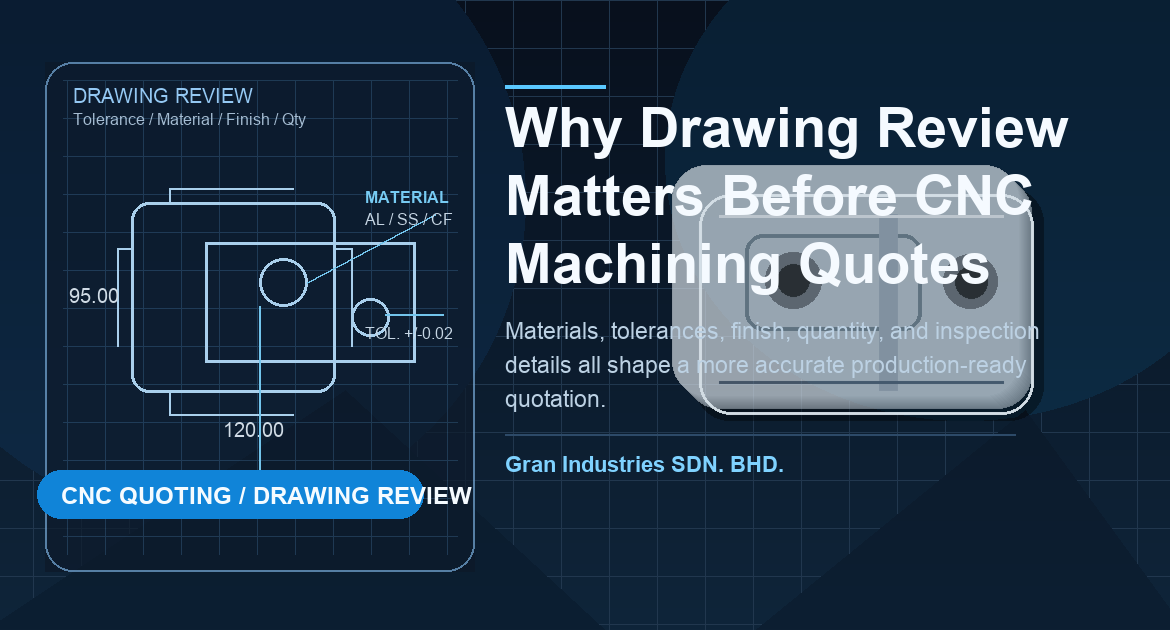
Drawing review is one of the most practical steps in custom manufacturing, yet it is often treated as a formality. In CNC machining, the information inside a drawing directly affects quotation accuracy, process planning, inspection scope, and production stability. When the review is handled carefully before machining begins, both the supplier and the customer can move forward with fewer assumptions and fewer preventable revisions.
For many custom parts, the quotation stage is the first technical checkpoint. It is where material requirements, tolerances, finishing expectations, and quantity planning are translated into actual manufacturing work. A clear drawing review helps that quotation reflect the real job instead of a rough estimate built on missing information.
What drawing review means in CNC machining
Drawing review is the process of checking whether the available files and specifications are complete enough to support a machining plan. This usually includes 2D drawings, 3D files, tolerance notes, material callouts, surface finish requirements, threaded features, and any customer-specific inspection expectations.
In practice, the review helps answer a few important questions before production starts:
- Is the material grade clearly defined?
- Are critical tolerances identified and realistic for the machining route?
- Do any features create tool access or fixturing challenges?
- Are surface finish and secondary processes specified clearly?
- Does the quantity suggest prototype machining or repeat production planning?
- Will extra inspection steps be required for certain dimensions?
When these points are addressed early, the supplier can quote with better alignment to the actual production scope.
Why drawing review improves quotation accuracy
A CNC machining quotation is shaped by more than machine time alone. Material sourcing, setup count, cutting strategy, tolerance control, deburring, finishing, and inspection effort all influence the final scope. If the drawing leaves any of these areas unclear, the quotation may require assumptions that create friction later.
Drawing review improves quotation accuracy by identifying gaps before they become production issues. Instead of revising the project after a purchase order is issued, both sides can clarify the requirements while the part is still being evaluated.
This is especially important for custom parts that involve:
- Tight tolerances on selected features
- Mixed machining operations such as milling, drilling, and secondary finishing
- Low-volume prototype quantities that may later scale into repeat orders
- Parts that must fit other assemblies or mating components
- Inspection records or customer-defined quality checkpoints
Common drawing issues that affect CNC machining quotes
Even well-prepared drawings can contain details that need clarification. A review helps surface these points while the quotation is still being prepared.
1. Incomplete material specifications
General material references such as “aluminum” or “stainless steel” are not always enough. Different grades behave differently in machining, finishing, and end-use performance. A supplier needs enough material detail to estimate tooling, sourcing, and process control correctly.
2. Tolerances applied too broadly
Not every dimension needs the same level of precision. If the drawing applies very tight tolerances across all features, machining time and inspection effort may increase more than necessary. A good review helps distinguish between critical dimensions and standard machining features.
3. Surface finish requirements that are not fully defined
Machined finish, bead blasting, anodizing, passivation, polishing, and edge treatment can all affect handling and process flow. If finishing requirements are unclear, the quotation may not match the production reality.
4. Features that are difficult to machine consistently
Deep pockets, thin walls, difficult hole positions, and small internal corners can affect cycle time and stability. Drawing review helps identify these challenges before they become hidden cost drivers.
Why this matters for prototype and repeat production
Drawing review is valuable for one-off prototypes, but it becomes even more important when a part may move into repeat manufacturing. A part that is reviewed carefully at the quotation stage is easier to support later because the key dimensions, material requirements, and inspection priorities have already been discussed.
This supports a smoother path from prototype development to stable production by reducing repeated clarification, improving consistency across batches, and making quality planning easier to maintain.
That same process discipline is part of what makes quality control in CNC machining more effective. Inspection works best when the drawing already communicates what must be verified and why those dimensions matter.
What customers should provide for a faster review
Customers can help accelerate quotation and review by sending a stronger information package from the beginning. Useful inputs often include:
- PDF drawing with complete dimensions and notes
- STEP or IGES file when available
- Material grade or approved alternatives
- Order quantity for prototype and future production
- Critical tolerance notes and fit requirements
- Surface finish or coating expectations
- Requested lead time and delivery destination
When these details are provided early, the machining supplier can review the job more efficiently and respond with a more practical quotation.
Drawing review as part of better manufacturing communication
In many CNC machining projects, delays do not come from cutting metal. They come from avoidable uncertainty before production begins. Drawing review reduces that uncertainty by turning specifications into a workable manufacturing plan.
For companies sourcing custom parts, that means fewer surprises in quotation, clearer discussion around tolerances and finishes, and better alignment between customer expectations and production capability. It also supports stronger decision-making when moving from early samples to long-term repeat orders.
If you are preparing a custom part inquiry, a clear drawing package will always improve the conversation. And if the supplier reviews that package carefully before quoting, the resulting manufacturing plan is more likely to stay on track through machining, inspection, and delivery.
For teams preparing new parts or repeat orders, Gran Industries supports project review around materials, machining feasibility, and production requirements. You can also explore our article on CNC machining services in precision manufacturing for broader process context, or send your drawing for quotation review when your project is ready.
Related Pages for the Next Step
These internal links help connect drawing review with process planning, quotation support, and broader CNC machining guidance.