
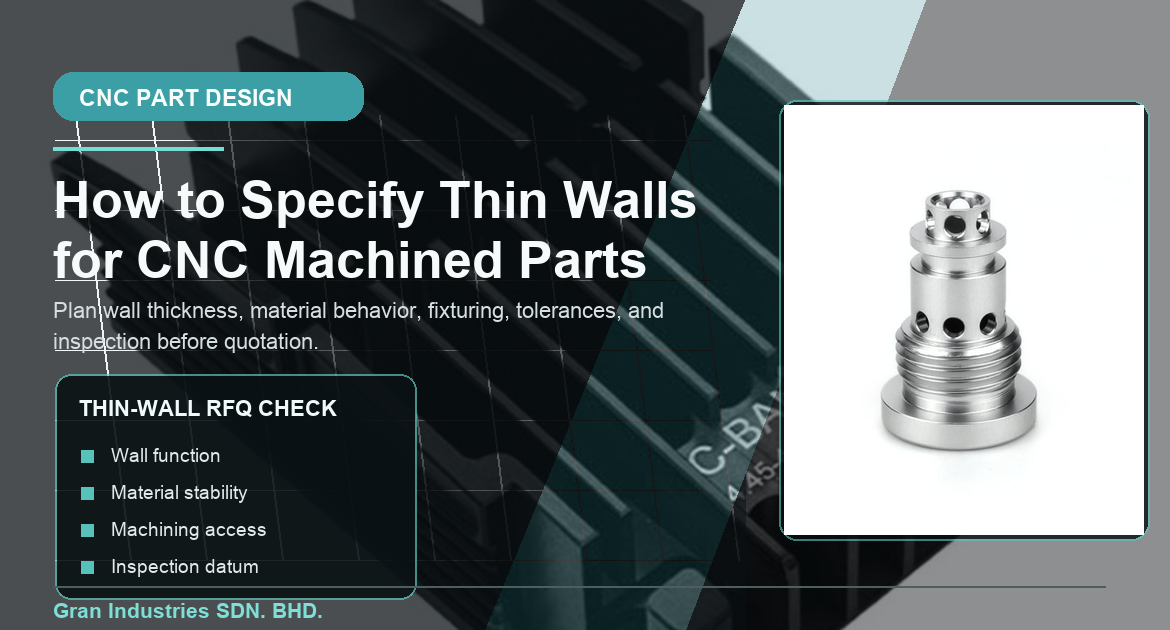
Thin walls are common in CNC machined parts because many designs need lower weight, compact packaging, reduced material use, or space for nearby assemblies. Housings, covers, brackets, trays, instrument panels, clamps, and lightweight structural parts may all include wall sections that are much thinner than the surrounding geometry. These features can be practical, but they need to be specified with manufacturing behavior in mind.
The main challenge is that thin walls do not behave like solid blocks during machining. Cutting forces, clamping pressure, heat, material stress, and deburring can all affect the final shape. A wall that looks straightforward in a CAD model may vibrate, move, bend, or become difficult to inspect if the drawing does not explain which surfaces and dimensions are truly critical.
At Gran Industries, thin-wall review is part of CNC machining quotation and process planning for custom parts. The goal is not to reject thin geometry automatically. It is to understand the function of the wall, the material, the tolerance expectations, and the inspection priority before machining begins.
Thin walls should be specified by function, not only by size
A thin wall may serve different purposes depending on the part. It may be a lightweight boundary, a cover surface, a sealing wall, a cosmetic enclosure, a rib for stiffness, or a clearance feature around another component. Each purpose changes how much precision and stability the wall needs.
Before quotation, it helps to clarify what the thin section must actually do:
- Does the wall control assembly fit or only provide clearance?
- Is the wall a sealing surface, locating surface, or cosmetic surface?
- Does the wall need to remain flat, parallel, or square to another feature?
- Will the wall receive threads, inserts, fasteners, or secondary finishing?
- Is the thin section needed for prototype testing or repeat production?
This functional view keeps the RFQ focused. A wall that only creates clearance may not need the same tolerance strategy as a wall that controls sealing, alignment, or a visible customer-facing surface.
Why thin walls affect CNC machining quotes
Thin walls can change the quotation because they may require different setup planning, cutting strategy, tool selection, support method, and inspection time. The machining team may need to remove material gradually, leave temporary stock for support, finish critical surfaces in a controlled sequence, or adjust clamping so the wall is not distorted before the final pass.
This is why thin-wall geometry should be reviewed during tinjauan gambar sebelum penawaran dan produksi mesin CNC. If the model shows thin sections but the drawing does not identify the critical dimensions, the supplier has to decide whether to quote a conservative process or ask for clarification.
Thin-wall parts often need closer review when they include:
- Large pockets with thin side walls
- Long unsupported ribs or rails
- Thin covers, plates, housings, or shells
- Deep features that limit tool access
- Thin walls close to threaded holes or precision holes
- Cosmetic outside faces with heavy internal material removal
Material choice changes thin-wall behavior
The same wall thickness may behave differently across material families. Aluminum is often used for lightweight machined parts, but thin sections can still move when material is removed unevenly. Stainless steel may require more care around cutting force, tool pressure, and heat. Copper alloys can present different edge and surface behavior. Engineering plastics may respond to clamping and heat in ways that affect final shape. Carbon fiber processing brings separate concerns around laminate support, edge quality, and dust control.
For that reason, thin-wall planning should stay connected to material selection. Projects involving aluminum alloy CNC processing, mesin CNC stainless steel, copper and copper-alloy CNC machining, engineering plastic machining, atau pengolahan serat karbon should not assume that one thin-wall rule fits every material.
If the material grade is flexible, it is useful to tell the supplier which requirements are fixed and which can be adjusted. Sometimes the design intent can be protected with a different grade, a small geometry change, or a revised tolerance approach.
Do not apply tight tolerances to every thin-wall surface
Thin walls become more difficult when tight tolerances are applied broadly. A design may need one critical distance, one flat mounting face, or one precision hole pattern, while other wall surfaces only need standard machined condition. If every surface is treated as equally critical, machining and inspection effort can increase without improving part function.
This follows the same practical logic as tight tolerances in CNC machining cost and lead time. Tight control is valuable when it protects fit, sealing, alignment, or performance. It becomes less useful when it is copied across non-critical faces because the drawing does not separate functional requirements from general geometry.
A clearer drawing can identify:
- Which thin-wall dimensions are function-critical
- Which surfaces can use general tolerances
- Whether the requirement applies after finishing or before finishing
- Whether local wall thickness matters more than full-surface form
- Which features should be checked during first article inspection
Consider tool access and internal corner design
Thin walls often appear around pockets, slots, steps, and internal cavities. These areas can create tool-access constraints. Deep narrow pockets may require longer tools, and longer tools can be less rigid. Small internal corner radii can also limit tool selection and make the machining process less stable.
Where possible, the design should leave enough access for practical machining. Helpful details include reasonable internal radii, clear pocket depth requirements, and notes showing which internal faces are critical. If a sharp internal corner is not functionally required, allowing a radius can support a more stable machining process.
Thin-wall features near holes deserve extra attention. A precision hole, threaded hole, counterbore, or fastener location can change the load path around a thin section. If the hole position or thread engagement is critical, the drawing should show that clearly instead of relying on the wall thickness alone to communicate the requirement.
Fixturing and machining sequence can protect the wall
Thin-wall parts may need a careful machining sequence. In some cases, the process may keep more material in place until late in the operation so the part remains supported. In other cases, the part may need custom soft jaws, controlled clamping pressure, or a sequence that balances material removal from multiple sides.
The drawing does not need to prescribe every machining step, but it should provide enough information for the supplier to plan the work. Assembly context, datum surfaces, critical faces, and inspection requirements all help the machining team decide how to hold the part and which areas should be finished last.
If flatness, parallelism, or datum relationships matter on a thin-wall part, those notes should be connected to flatness and parallelism requirements for CNC machined parts. Thin geometry can make those controls more sensitive to setup and support conditions.
Edge breaks and deburring need realistic expectations
Thin walls can be more sensitive to edge treatment than thicker features. A burr on a thin edge may interfere with assembly or handling, but aggressive deburring can alter the edge more than intended. This is especially important around covers, slots, vents, pockets, and cosmetic edges.
The RFQ should explain whether the edge is functional, cosmetic, or only needs safe handling. When a thin edge must fit another part, seal against a surface, or remain visually clean, the drawing should connect the edge note to the actual area of concern. This helps avoid treating every edge the same way.
For more detailed edge planning, thin-wall projects can be reviewed alongside edge break and deburring specifications for CNC machined parts.
Surface finish and secondary processes can change the final result
Surface finish requirements, coatings, anodizing, passivation, polishing, or other secondary processes can affect how thin-wall parts should be planned. A surface that needs a specific finish may require extra stock, a controlled final pass, or protection during handling. A cosmetic outside wall may also need different treatment from a hidden internal pocket.
When surface finish matters, the drawing should identify the affected surfaces and whether the final dimension applies before or after secondary processing. This avoids confusion when a thin wall has both dimensional and appearance requirements.
This is closely related to perencanaan permukaan akhir untuk suku cadang mesin CNC, especially when the same face is both thin and visible or function-critical.
Inspection should focus on the features that control acceptance
Thin-wall inspection should match the part’s function. It may not be useful to measure every thin surface with the same level of detail. Instead, the inspection plan should focus on the features that determine fit, assembly, sealing, appearance, or customer acceptance.
Useful inspection questions include:
- Which wall thickness dimensions must be recorded?
- Which datum surfaces control the part orientation?
- Which thin-wall faces are cosmetic or sealing surfaces?
- Does the part need first article inspection before repeat production?
- How should the part be supported during measurement?
When the part will move from prototype to repeat production, these inspection priorities should be clarified early. They can also be tied to first article inspection in CNC machining quality control so the first sample confirms the right features.
What to include in a thin-wall CNC machining RFQ
A stronger RFQ for thin-wall CNC machined parts usually includes:
- Gambar 2D dan model 3D jika tersedia
- Material grade or acceptable material alternatives
- Minimum wall thickness and the reason it matters
- Critical dimensions separated from general dimensions
- Datum surfaces and assembly orientation
- Surface finish, coating, and cosmetic requirements
- Edge break or deburring expectations for thin edges
- Prototype quantity, production quantity, and inspection requirements
This information helps the supplier quote the job as a real manufacturing project instead of only a thin geometry model. It also reduces the risk of discovering stability, tolerance, or finishing issues after machining has already started.
Clear thin-wall requirements support better custom parts
Thin walls can make CNC machined parts lighter, more compact, and more efficient, but they need practical specification. Material behavior, wall function, tolerance priority, machining access, edge condition, finishing, and inspection all affect whether the final part meets the design intent.
If your custom CNC machined part includes thin walls, pockets, housings, covers, ribs, or lightweight features, Gran Industries can review the drawing, material, tolerance approach, and production intent before quotation. You can also kirim detail proyek Anda untuk ditinjau ketika Anda sudah siap.