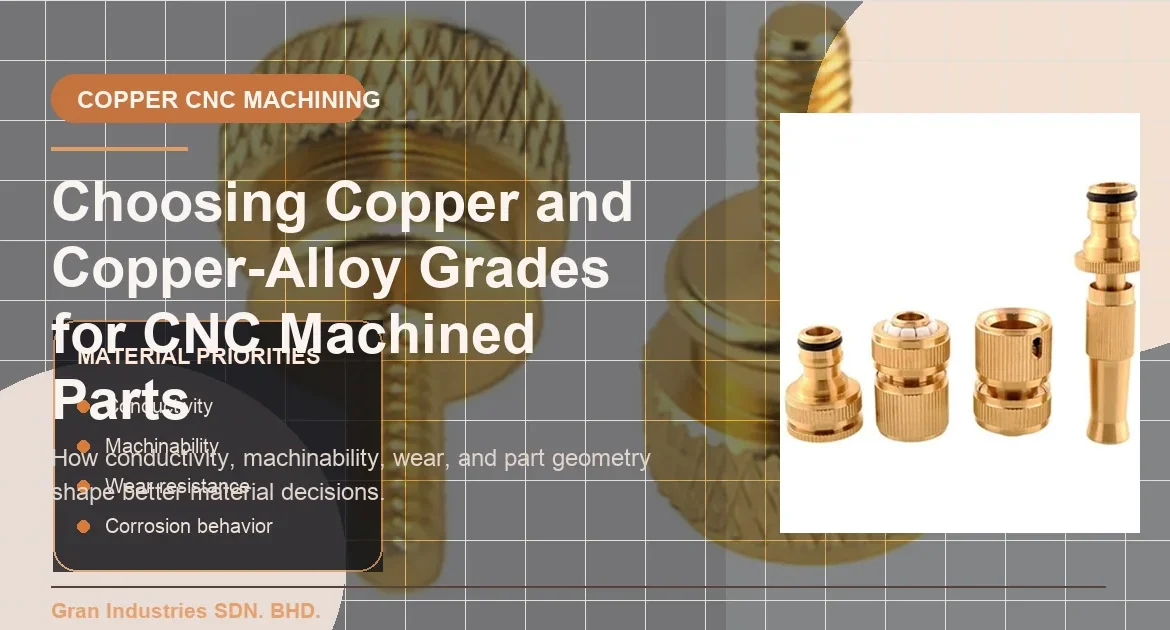
In the world of custom precision manufacturing, copper and its alloys—brass and bronze—occupy a unique position. Renowned for their exceptional electrical and thermal conductivity, corrosion resistance, and aesthetic appeal, these materials are indispensable in sectors ranging from renewable energy and electric vehicles (EVs) to high-end electronics and industrial plumbing.
However, from a CNC machining perspective, copper is often classified as a “difficult” material. Its high ductility and “gummy” nature can lead to excessive tool wear, chip evacuation issues, and thermal deformation if not handled by an experienced machine shop.
This technical guide explores the characteristics of various copper alloys, the challenges of machining them, and best practices for engineers looking to source high-precision copper components.
Why Copper? Key Properties for Industrial Applications
Engineers choose copper primarily for three reasons:
- Electrical Conductivity: Second only to silver, copper is the standard for electrical connectors, busbars, and circuit components.
- Thermal Conductivity: Copper’s ability to move heat rapidly makes it the material of choice for high-performance heat sinks, liquid cooling cold plates, and heat exchangers.
- Corrosion Resistance: Copper alloys naturally form a protective patina, making them ideal for marine environments and fluid handling systems.
Common Copper Alloys Used in CNC Machining
Not all copper is the same. Selecting the right grade depends on the balance between conductivity and machinability.
1. Pure Copper (C11000 / C10100)
C11000 (Electrolytic Tough Pitch) is the most common pure copper. It offers 101% IACS conductivity but is highly ductile and “gummy,” making it challenging to achieve tight tolerances and fine surface finishes. C10100 (Oxygen-Free) is used in vacuum applications and high-end audio where maximum purity is required.
2. Free-Cutting Brass (C36000)
Brass is the gold standard for machinability. Due to the inclusion of lead, C360 brass produces small, brittle chips that evacuate easily, allowing for extremely high spindle speeds and exceptional tool life. It is ideal for complex connectors, fasteners, and fluid valves.
3. Bronzes (C51000 Phosphor Bronze, C63000 Aluminum Bronze)
Bronze alloys are prized for their hardness and wear resistance. Phosphor bronze is commonly used for electrical springs and bellows, while aluminum bronze is a heavy-duty material for bearings, bushings, and marine hardware.
| Material Grade | Peringkat Kemampuan Mesin | Primary Application |
|---|---|---|
| C36000 Brass | 100% (Base) | Valves, fittings, connectors |
| C14500 Tellurium Copper | 85% | Electrical parts requiring high precision |
| C11000 Pure Copper | 20% | Busbars, heat sinks, electrodes |
| C63000 Aluminum Bronze | 30% | Bearings, marine hardware |
Technical Challenges in Copper CNC Machining
1. Tooling and “Gumminess”
Pure copper does not “chip” like aluminum or steel; it tends to smear and stick to the cutting edge. This leads to Built-Up Edge (BUE), which ruins surface finish and quickly degrades the tool. We use polished, high-rake carbide tools with specialized coatings to mitigate this.
2. Thermal Management
Because copper conducts heat so effectively, the heat generated at the cutting tip quickly spreads through the entire part. This can cause thermal expansion during the machining process. If the machinist does not account for this, the part may shrink out of tolerance once it cools down on the inspection table.
3. Work Hardening
Copper can work-harden rapidly. If the tool is not cutting cleanly (i.e., rubbing instead of shearing), the surface becomes significantly harder, making subsequent passes more difficult and increasing the risk of tool breakage.
Design for Manufacturability (DFM) Tips for Copper Parts
To reduce costs and improve quality when designing copper components, consider the following:
- Avoid Deep, Narrow Holes: Copper’s gumminess makes chip evacuation difficult in deep blind holes. Limit hole depth to 4x diameter if possible.
- Specify Realistic Tolerances: While ±0.01mm is achievable in brass, it is significantly more expensive in pure copper due to thermal drift. Use looser tolerances for non-mating features.
- Radius Internal Corners: Sharp internal corners require slow EDM processes or very small tools. Standardize internal radii to match common end mill sizes (e.g., 1mm or 2mm).
- Consider Tellurium Copper: If your application allows, C145 Tellurium copper offers nearly the same conductivity as C110 but machines much more like brass.
Surface Finishing and Post-Processing
Copper parts often require secondary treatments to prevent oxidation or improve performance:
- Electroplating (Nickel/Gold/Silver): Essential for electrical components to prevent tarnish and improve solderability.
- Passivation: A chemical treatment to enhance the natural oxide layer and prevent corrosion.
- Bead Blasting: Provides a uniform matte finish, ideal for heat sinks and visible industrial components.
- Electropolishing: Removes a microscopic layer of material to create a mirror-like finish and deburr complex internal features.
Gran.my: Your Partner for Precision Copper Machining
At Gran.my, we specialize in high-conductivity components for demanding industries. Our 5-axis CNC capabilities allow us to machine complex bagian tembaga dan paduan tembaga in a single setup, ensuring maximum concentricity and positional accuracy.
Our process includes:
- Material Certification: We provide full traceability for all copper grades (C110, C101, C360, etc.).
- Specialized Tooling: Use of PCD and specialized carbide cutters for “gummy” materials.
- Climate-Controlled Inspection: Measuring parts at a stabilized 20°C to ensure thermal accuracy.
Learn more about our Proses pemesinan CNC or explore our other services including Aluminium CNC dan Stainless Steel Machining.
Kesimpulan
Machining copper requires more than just high-quality machines; it requires a deep understanding of the material’s thermal and mechanical behavior. Whether you are developing a next-generation EV power module or a high-frequency RF connector, choosing a manufacturer with specific copper expertise is critical.
Ready to start your next project?