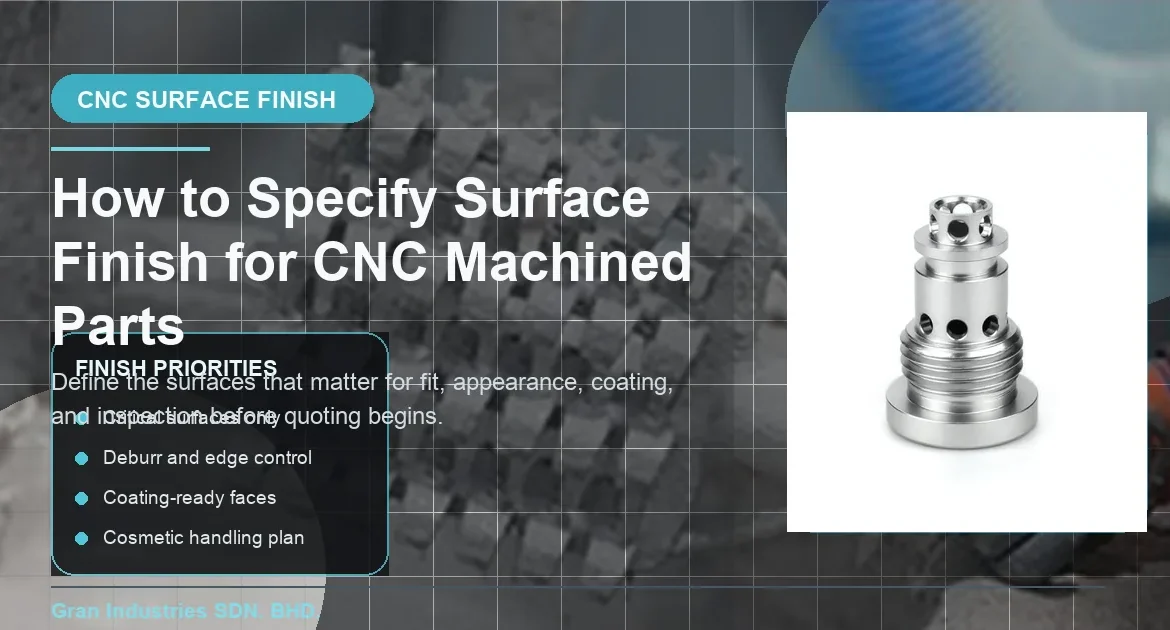
Surface finish is often discussed late in a machining project, even though it affects quotation, process planning, and inspection from the beginning. A drawing may define the shape and dimensions of the part clearly, but if the required finish is not explained well, the supplier still has to make assumptions about what level of machining, deburring, polishing, blasting, or secondary treatment is actually expected.
That gap can create avoidable problems. A finish that is acceptable for a hidden bracket may not be acceptable for a sealing face, a sliding feature, or a visible exterior component. In the same way, a cosmetic expectation that is not identified early can change the real machining route, even when the part geometry stays the same.
At Gran Industries, surface finish review is part of the broader discussion around drawing clarity, material fit, and production intent. The practical goal is to identify which surfaces matter, what type of finish is needed, and how those expectations should be handled before machining moves forward.
What surface finish means in CNC machining
In CNC machining, surface finish refers to the condition of the machined surface after cutting and any related secondary steps. Depending on the part, that may include the visible tool pattern, the relative smoothness of a face or bore, edge condition after deburring, and whether a follow-up process such as polishing, blasting, brushing, anodizing, plating, or coating is required.
Not every part needs the same finish level on every feature. Some surfaces mainly need clean machining and broken edges. Others may need a more controlled result because they affect assembly fit, sealing, sliding contact, appearance, or downstream finishing.
Why surface finish should be discussed before quotation
Surface finish is not only a final cosmetic issue. It can change how the part is manufactured and how much time the supplier needs to allocate for inspection and secondary handling.
Finish expectations may affect:
- Toolpath strategy and machining passes on critical faces or bores
- Whether extra deburring, polishing, brushing, or blasting steps are needed
- How the part is protected during handling and packing
- Whether surfaces are being prepared for anodizing, plating, painting, or bonding
- How visible cosmetic standards should be judged on production parts
- Quotation accuracy for prototype work and repeat orders
This is one reason drawing review before quotation is so important. If finish expectations are left open, the quote may not reflect the real manufacturing scope of the part.
Common reasons a machined part needs a more defined finish
1. Assembly and fit
Some surfaces support direct contact with mating parts, sealing elements, bearings, fasteners, or alignment features. In these cases, the surface condition may affect how the component seats, slides, seals, or interfaces during assembly.
2. Appearance on visible components
Exterior faces on covers, panels, accessory parts, and customer-facing components often need a more deliberate finish standard than purely functional internal features. If appearance matters, the drawing or RFQ should identify that clearly instead of assuming a general machined look will be acceptable.
3. Coating or secondary processing
Parts that will be anodized, plated, painted, bonded, or marked often need finish planning before the secondary process begins. Surface preparation affects the final result, so the machining route should support the post-processing requirement rather than treat it as an unrelated step.
4. Sliding contact or wear-related surfaces
Guide features, contact surfaces, sleeves, seats, and other functional areas may need closer finish attention when friction behavior matters. The useful question is not whether the whole part should be smoother. It is which surfaces actually affect performance.
What to specify on the drawing or RFQ
Many finish-related delays happen because a project requests a “good finish” without defining what that means. A better approach is to identify the surfaces that matter and explain why they matter.
Useful inputs may include:
- Which surfaces are cosmetic, sealing, sliding, or otherwise function-critical
- Whether a general machined finish is acceptable on non-critical areas
- Any roughness target or customer finish standard when one is already defined
- Whether edges should only be deburred or require more controlled edge treatment
- Whether the part will receive anodizing, plating, painting, powder coating, or bonding
- Which faces must be protected from scratches or handling marks
- How prototype expectations differ from repeat-production expectations
These details help the machining supplier make better decisions early, especially when the finish requirement affects setup, secondary operations, or inspection logic.
Why not every surface needs the same finish level
Applying the highest finish requirement to every surface often increases cost without improving part performance. Many custom parts include a mix of critical and non-critical features. A sealing face may need closer control, while the outside of a hidden support block may only need clean machining and standard deburring.
This is similar to the way tight tolerances affect cost and lead time. The strongest specification is usually the one that applies more control where it matters and avoids unnecessary burden where it does not.
How material choice influences achievable finish
Surface finish should be considered together with material selection. Different materials respond differently to cutting, edge condition, and post-processing.
- Aluminum parts may be reviewed with the final anodized appearance in mind
- Stainless steel parts may need finish planning around visible surfaces, corrosion-related expectations, or contact features
- Engineering plastics may need finish review based on fit, sliding behavior, or edge sensitivity
- Carbon fiber components may require special attention to machining direction, edge condition, and cosmetic expectations after cutting
That is why finish planning often connects directly to the chosen manufacturing route and service category, whether the project involves aluminum alloy CNC processing, stainless steel CNC machining, engineering plastic machining, or lavorazione della fibra di carbonio.
How finish requirements affect quality control
Finish expectations should also be reflected in inspection planning. If a part includes critical cosmetic zones, sealing surfaces, or areas prepared for secondary treatment, acceptance should not rely only on dimensional checks. The inspection method should match the feature’s role in actual use.
This is one reason quality control in CNC machining should be treated as part of process planning. A part can be dimensionally correct but still fail the intended use if finish-sensitive surfaces are not reviewed properly.
Questions customers should answer before sending the job
Before requesting a quote, it helps to clarify a few practical points:
- Is the finish mainly functional, cosmetic, or both?
- Which surfaces are critical and which can follow a general machined finish?
- Will the part receive a coating or secondary treatment after machining?
- Does the project need first-sample validation for finish appearance before batch production?
- Are there reference photos, approved samples, or customer standards the supplier should review?
The more clearly these questions are answered, the easier it becomes to quote the job correctly and avoid revisions once parts are already in process.
Surface finish planning helps custom parts move more smoothly
A better surface finish specification does not mean making every machined part smoother or more expensive. It means defining what matters for function, appearance, and downstream processing before manufacturing starts. When critical surfaces, edge expectations, and coating plans are clear, the machining route becomes easier to control and the quotation becomes more dependable.
If you are sourcing custom machined parts and need support on finish expectations, drawing review, or process fit, Gran Industries can review the part file and production intent before quotation. You can also send your drawing for review to discuss material, finish, and quantity requirements with our team.