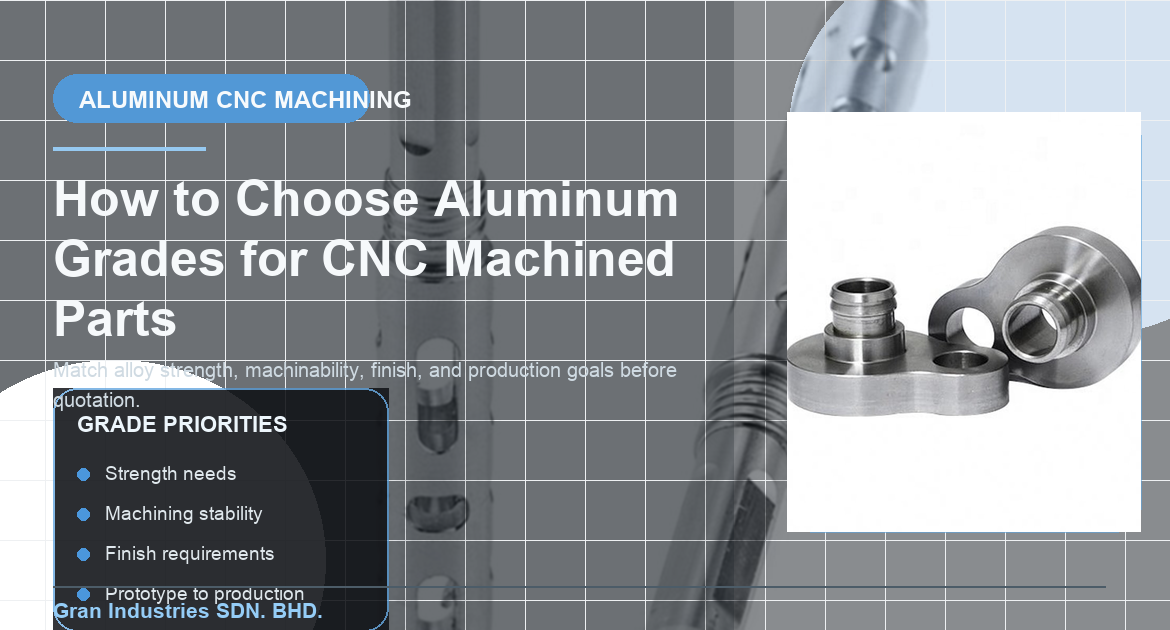
Aluminum is one of the most common materials used for custom CNC machined parts because it offers a useful balance of low weight, machining efficiency, corrosion resistance, and finishing flexibility. Even so, it is usually not enough to specify only “aluminum” on a drawing or RFQ. Different grades behave differently in strength level, machining response, bend sensitivity, finish appearance, and long-term production suitability.
That is why aluminum grade selection should be reviewed before quotation and production begin. The practical goal is not to default to the strongest alloy or the most familiar material name. It is to choose the grade that matches the part’s geometry, service condition, finish expectations, and order plan so the machining route stays realistic from prototype samples through repeat production.
At Gran Industries, this discussion normally sits alongside drawing review, tolerance planning, surface requirements, and manufacturing method selection. When the alloy direction is clarified early, it becomes easier to quote accurately, plan the correct machining process, and avoid unnecessary material changes later in the project.
Why aluminum grade selection matters before machining starts
Different aluminum grades can all look suitable at a high level, yet they do not create the same machining and product outcomes. The selected grade can affect:
- How easily the part can be milled, turned, drilled, and tapped
- Whether the component better suits structural loading or general-purpose use
- How the part responds to anodizing, blasting, polishing, or coating
- How stable thin walls, threaded areas, and cosmetic faces remain during machining
- Whether prototype decisions will still make sense in repeat production
- What inspection and acceptance points deserve closer attention
This is one reason drawing review before quotation matters so much. If alloy choice is left vague, the quotation may be built around assumptions that do not fully match the actual use of the part.
Questions to answer when choosing an aluminum grade
In many projects, the best aluminum direction becomes clearer when a few practical questions are answered first.
1. Does the part need mainly light weight and general machinability, or higher strength?
Some aluminum parts are covers, housings, brackets, bezels, and fixture details where general machining stability and practical finishing matter more than maximum strength. Others are more structural and may need a higher-strength alloy because the component is carrying load, resisting impact, or holding dimensional stability in a more demanding application. Clarifying that difference early helps narrow the material direction.
2. Will the part include thin walls, deep pockets, or many threaded features?
Part geometry changes which alloy is most practical. A simple plate or support block leaves more flexibility. A complex housing, thin-walled component, or heavily threaded part may benefit from an alloy choice that supports more stable machining and cleaner feature generation. Geometry should always be reviewed together with the material, not as a separate decision.
This connects directly to how tight tolerances affect machining cost and lead time. When a part already has demanding dimensional requirements, alloy choice can make the overall production plan either easier or more difficult to control.
3. What kind of environment will the finished part see?
Some custom aluminum parts are used indoors in controlled equipment settings. Others may face humidity, outdoor exposure, handling wear, or a follow-up finishing process intended to improve corrosion behavior and appearance. The service condition should be clear enough that the alloy can be matched to the real environment instead of chosen only by habit.
4. Does the project need cosmetic finishing such as anodizing or blasting?
Finish expectations matter because appearance parts and hidden functional parts are not reviewed the same way. If the drawing includes visible faces, branding-sensitive surfaces, or a specific anodized presentation, the alloy discussion should account for that. Material and finish planning need to support each other from the start.
That is why this topic overlaps with surface finish planning for CNC machined parts. A finish requirement that looks simple on paper can change the best alloy choice for the job.
5. Is the order still in prototype stage or moving toward scheduled production?
Prototype work may focus on testing fit, appearance, or general assembly function before the final production specification is fixed. Repeat production usually needs a more stable material decision that supports consistent sourcing, machining time, and inspection control. This is why aluminum grade choice should be reviewed together with the expected order path, not only the first sample build.
That fits the same planning logic discussed in prototype versus production CNC machining. The right answer for a trial run may not be the strongest long-term answer if the project is scaling.
Common aluminum grade directions for CNC machined parts
Different applications call for different alloys, but several directions appear often in custom aluminum machining work.
6061-type aluminum for versatile general-purpose CNC parts
For many housings, brackets, covers, support components, plates, and custom OEM details, a general-purpose aluminum grade is often the practical starting point. This type of material is widely used because it supports good machinability, broad application fit, and common finishing routes. It is frequently considered when the project needs a balanced solution rather than the highest possible strength.
7075-type aluminum for higher-strength applications
When the part needs more emphasis on strength and stiffness, a higher-strength aluminum alloy may be the better direction. This can apply to structural details, performance-driven components, and machined parts where the loading condition is more demanding. The tradeoff is that the alloy should still be reviewed against machining complexity, finish requirements, and actual use instead of being selected only because it is seen as the premium option.
5052-type or sheet-oriented aluminum directions for formed or cover-style parts
Some projects involve aluminum parts that are not purely about high-strength block machining. Covers, guards, panels, and lighter formed details may point toward a different alloy direction depending on how much cutting, shaping, or secondary forming is involved. In those cases, the best answer may depend on how the part is manufactured as much as on the final application.
Application-specific alloys for conductivity, finishing, or production fit
Some custom jobs require a more specialized review because the part must balance cosmetic finish, conductivity, plate stock availability, or a customer-defined industry standard. In those cases, the drawing, usage environment, and production plan should guide the recommendation instead of assuming one aluminum family works best for every part category.
The practical point is to choose the alloy that fits the part’s real job, rather than choosing by material reputation alone.
How part geometry changes the best aluminum choice
Material selection should always be reviewed together with part shape. An alloy that works well for a simple spacer or adapter plate may be less practical for a thin-walled housing, a part with many tapped holes, or a detail with large cosmetic surfaces that must stay consistent after finishing.
Geometry review should normally cover:
- Milled faces, pockets, slots, and datum surfaces
- Turned diameters, grooves, and concentric features
- Tapped holes, countersinks, and repeated fastener locations
- Wall thickness, unsupported sections, and edge stability
- Cosmetic faces, sealing areas, or other function-critical surfaces
That is why alloy planning often connects directly to aluminum alloy CNC processing service review. The process route and the material need to support each other if the part is going to stay efficient and repeatable in production.
Why finish and inspection still matter with aluminum parts
Aluminum parts are often chosen partly because they can be machined cleanly and finished attractively. That means inspection and finish control should not be treated as separate afterthoughts. A part can be dimensionally acceptable but still create trouble if visible faces, thread quality, edge condition, or finish-ready surfaces are not reviewed carefully enough.
This is one reason quality control in CNC machining matters as much for aluminum as for any other material family. Inspection planning should reflect the actual functional and cosmetic priorities of the part.
What to send when requesting a quote for aluminum CNC parts
A clearer RFQ usually leads to a more useful alloy recommendation. For aluminum machining projects, useful inputs often include:
- 2D drawing and 3D file when available
- Preferred alloy if one is already being considered
- Expected quantity for sample builds and repeat orders
- Critical dimensions, threads, and fit-sensitive surfaces
- Any anodizing, blasting, coating, or cosmetic finish requirement
- Notes about the working environment and loading condition
- Assembly details that explain how the part functions with surrounding components
When that information is provided early, the supplier can review alloy choice against real manufacturing needs instead of relying on general assumptions.
Choosing the right aluminum grade for the job
The best aluminum grade for a CNC machined part depends on what the part needs to do in actual service. Strength level, machining stability, corrosion exposure, geometry, finish expectations, and production intent all matter. A material that works well in one project may be unnecessary or inefficient in another if the part category and manufacturing priorities are different.
For custom aluminum housings, brackets, plates, support components, and machined assemblies, the better approach is to review alloy choice together with drawing clarity, tolerance priorities, finishing requirements, and expected order volume before production begins. That makes the quotation more useful and helps the machining plan stay stable from sample approval into repeat manufacturing.
If you are sourcing custom aluminum CNC parts, Gran Industries can review the drawing, quantity, alloy direction, and finish requirements before quotation. You can also explore our aluminum alloy CNC processing service page for related capability context, or send your part details for review when you are ready.