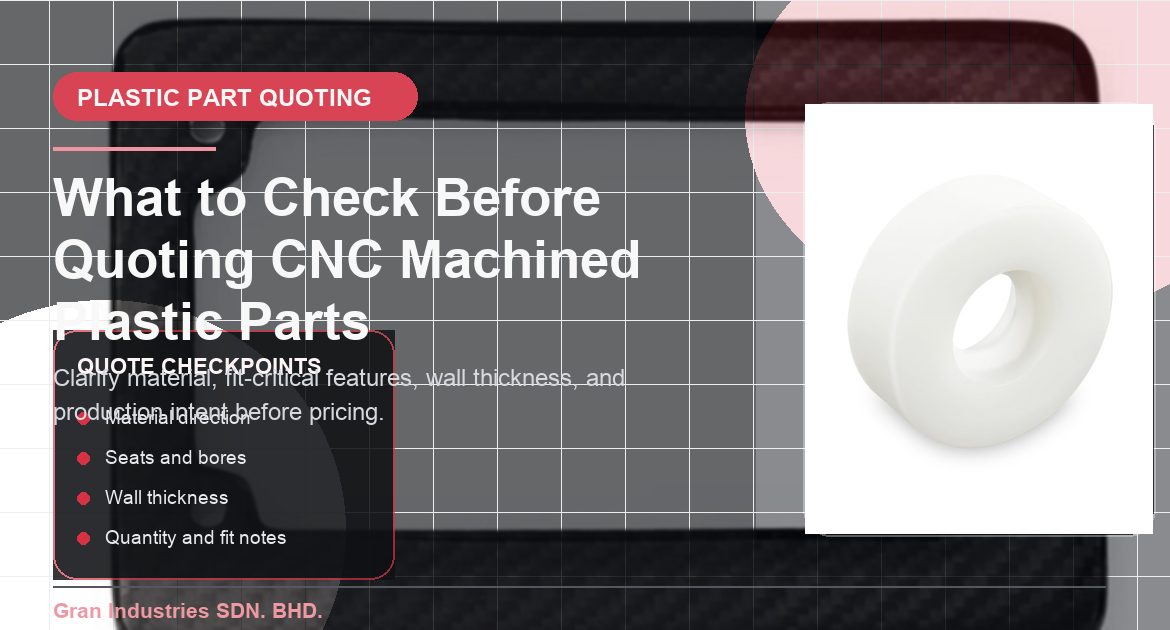
CNC machined plastic parts are often selected because they solve application problems that metals do not solve as efficiently. Depending on the part, the priority may be low friction, electrical insulation, chemical resistance, lower weight, quieter operation, or smoother movement against a mating component. Even so, quoting plastic parts accurately usually requires more than receiving a simple shape and quantity.
Engineering plastics behave differently from one another, and they also respond differently to wall thickness, hole patterns, bearing seats, thread details, edge condition, and finish expectations. A part that looks straightforward on a drawing can become harder to quote correctly if the material is still undecided, if fit-critical areas are not identified clearly, or if the request does not explain whether the order is a sample run or a repeat-production item.
That is why quoting plastic machining work should start with the same disciplined review used for other custom manufacturing projects. At Gran Industries, the practical goal is to understand how the part needs to function after machining, which features need closer control, and what production path the customer is planning before quotation is finalized.
Why plastic part quotations need a more specific review
Plastic components are sometimes treated as easier to manufacture because they may be lighter and easier to cut than many metals. In practice, a reliable quotation still depends on understanding the details that shape machining stability and final part performance. Those details can include:
- Which engineering plastic or plastic ester material is being considered
- Whether the part is mainly turned, milled, or a mixed-operation component
- How wall thickness, unsupported spans, and hole placement affect machining stability
- Which diameters, seats, bores, or contact surfaces matter most after machining
- Whether edge quality, cosmetic appearance, or assembly cleanliness are important
- Whether the job is a one-time prototype or likely to continue into repeat production
Это одна из причин. рассмотрение чертежей перед котировкой remains important even when the part material is plastic instead of metal. If the machining supplier has to assume too much, the quote can lose accuracy before production starts.
Start with the material direction, not only the part shape
One of the first questions in a plastic-part RFQ is which material family is actually intended. Different engineering plastics can support very different operating conditions and machining behavior. The quote becomes more reliable when the request explains whether the part priority is wear behavior, dimensional stability, electrical insulation, moisture resistance, chemical exposure, or a low-friction sliding function.
If the final material has not been fixed yet, the quotation request should at least explain the part’s working environment and function. That gives the machining team a better basis for material discussion instead of treating all machined plastics as interchangeable.
This is closely related to our article on how to choose engineering plastics for CNC machined parts. A quote is only as useful as the material direction behind it.
Identify the features that are actually fit-critical
Plastic part drawings often include a mix of general geometry and a smaller number of features that matter much more than the rest. These may be bearing seats, shaft bores, guide surfaces, mounting holes, counterbores, shoulders, grooves, or contact faces that control assembly behavior after machining.
When those fit-critical areas are not identified clearly, the machining plan may treat too many features as equally sensitive or may overlook the ones that need closer attention. A better quotation request usually highlights:
- Bearing or bushing seat dimensions
- Sliding surfaces and low-friction contact areas
- Hole patterns tied to assembly alignment
- Shoulders, grooves, and stop faces that affect positioning
- Threads or inserts that must assemble cleanly
- Faces that control sealing, support, or cosmetic appearance
That same thinking connects to контроль первого изделия при контроле качества обработки на станках с ЧПУ. The clearer the critical features are at quote stage, the easier it becomes to confirm them later in production.
Wall thickness and unsupported geometry can change the quote
Plastic part geometry should be reviewed carefully because thin walls, long unsupported sections, and narrow ribs can change how the part behaves during machining. A simple block, spacer, or sleeve is usually easier to plan than a cover with thin sections, a guide component with long slender features, or a part that combines pockets, holes, and bearing-seat requirements in one body.
Important review points often include:
- Very thin walls or edges that may need more careful handling
- Deep pockets or long slots that influence tool access
- Large flat surfaces where stability and appearance both matter
- Cross-holes near edges or seat locations
- Mixed turned and milled features that require more than one setup approach
These geometry details can affect cycle planning, part handling, and inspection scope. They also help the supplier judge whether the component is better treated as a mainly turned part, a mainly milled part, or a mixed-operation custom detail.
Hole details, bores, and threads should be defined clearly
For machined plastic parts, holes are often more important than outside profiles. A mounting hole may be simple, while a bearing location, press-fit seat, threaded interface, or concentric bore may need more disciplined review. This matters because the quote should reflect the actual functional interfaces, not only the outside shape of the component.
A stronger RFQ normally clarifies:
- Whether a hole is only for clearance or for controlled fit
- If bores relate to bearings, sleeves, shafts, or mating inserts
- Whether threads are molded, cut, tapped, or combined with hardware
- Which diameters need better concentricity or surface condition
- If the part includes counterbores, countersinks, or stepped holes for assembly
That level of detail helps the machining team separate standard feature work from the areas that deserve more process control.
Surface condition and edge quality still matter on plastic parts
Plastic components often need cleaner edge handling than customers expect. Even when the part is function-first rather than cosmetic, assembly behavior can still be affected by burrs, rough seat transitions, edge break consistency, or surface condition on contact areas. A quote becomes more accurate when these expectations are stated early.
This can apply to:
- Edge clean-up on covers, plates, and housings
- Seat refinement on bushings, rollers, and guide parts
- Appearance-sensitive outer surfaces
- Friction surfaces that should stay smooth and controlled
- Components that will be inspected visually before assembly
If the part also has visible faces or assembly-sensitive edges, it helps to mention that in the RFQ rather than leaving the expectation implied. This follows the same logic discussed in surface finish planning for CNC machined parts, even though the material family is different.
Quantity and production intent affect the right quotation approach
The quote for a plastic prototype is not always the same as the best plan for repeat production. Sample work may focus on validating fit, seat condition, and assembly function. Ongoing production usually needs more attention on repeatability, process stability, inspection discipline, and consistent material supply.
That is why the RFQ should clarify whether the part is:
- A first sample for design validation
- A low-volume custom part for occasional reorder
- A repeat production item that needs more stable process planning
- A prototype likely to scale if testing succeeds
The quotation becomes more useful when the supplier understands where the part sits in that progression. This matches the planning logic in prototype versus production CNC machining, where process choices should follow the expected order path.
What to send for a faster quote on CNC machined plastic parts
For engineering plastic and plastic ester components, the most useful quotation packages usually include:
- 2D drawing and 3D file when available
- Target material or at least the intended operating condition
- Expected quantity for samples and future orders
- Critical bores, seats, holes, or sliding surfaces marked clearly
- Notes on edge condition, appearance, or surface expectations
- Assembly context for any bearing, sleeve, shaft, or guide function
- Any inspection requirement that applies to selected dimensions
With that information, the supplier can review the job based on actual process fit instead of broad assumptions. Customers planning plastic rollers, bushings, sleeves, insulators, guide parts, and custom OEM components can also review our engineering plastic machining service page for the types of features and part categories typically supported.
Quoting plastic parts more accurately before production begins
A better quote for CNC machined plastic parts starts with more than basic geometry. Material direction, fit-critical features, wall thickness, hole details, edge expectations, and production intent all influence how practical the machining route will be. When those points are clear early, the quote becomes more accurate and the production path becomes easier to control.
For custom plastic bushings, rollers, sleeves, housings, insulators, guide parts, and OEM components, the strongest approach is to connect the RFQ directly to the part’s actual function after machining. If you are preparing a plastic-part inquiry, Gran Industries can review the drawing, material direction, quantity, and fit-sensitive features before quotation. You can also send your project details here to start the review.