Custom parts do not move through CNC machining in the same way at every stage of a project. A part that is still being tested, adjusted, or approved usually needs a different manufacturing approach from a part that is already stable and ready for repeat output. That is why the difference between prototype machining and production machining matters early, not only after quantities increase.
For buyers, engineers, and product teams, the decision is not simply about ordering a small batch or a large batch. The better question is how the part should be reviewed, machined, inspected, and communicated based on its current development stage. When that choice is made clearly, projects usually move with fewer revisions, more accurate quotations, and better alignment between technical requirements and manufacturing expectations.
What prototype CNC machining is meant to achieve
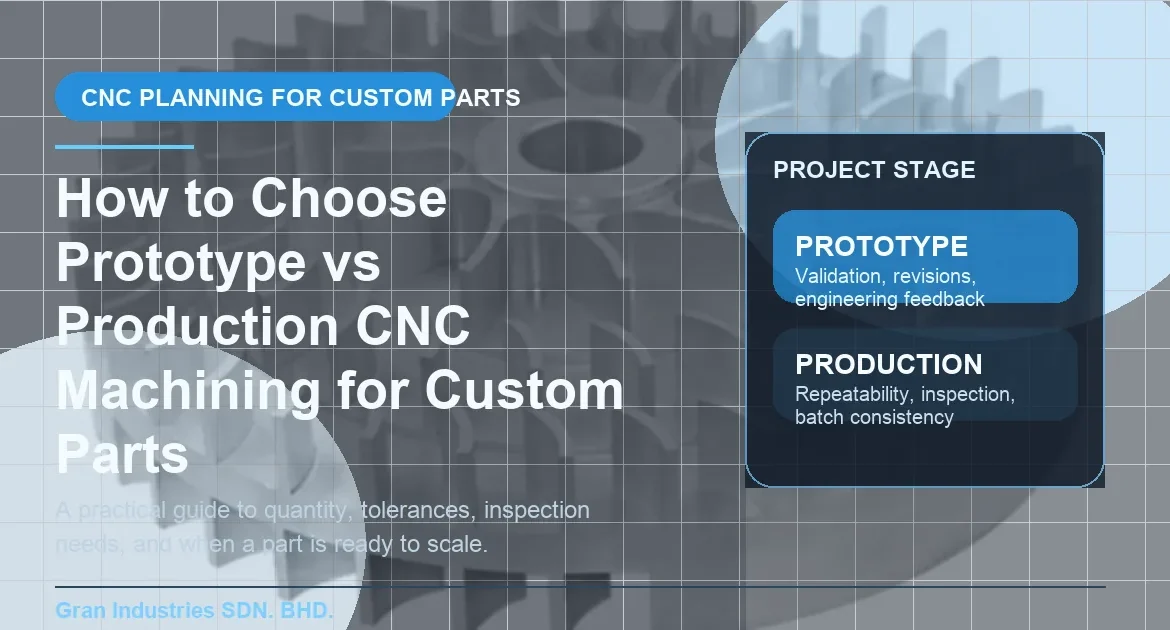
Prototype CNC machining is generally used when a part is still being validated. At this stage, the goal is often to confirm geometry, fit, assembly function, material behavior, or appearance before the design is released for more stable repeat manufacturing.
Prototype work is often associated with:
- Early-stage design validation
- Functional testing and assembly checks
- Evaluation of materials or finishes
- Revision cycles between drawing updates
- Smaller quantities with more engineering attention per part
Because the part may still change, prototype machining usually benefits from closer drawing review, more active communication, and flexibility around adjustments discovered during the first run.
What production CNC machining is meant to achieve
Production CNC machining is typically used when the part definition is more stable and the focus shifts from validation to repeatability. At this stage, the machining process needs to support more predictable output across multiple parts or repeat orders, with clearer expectations around lead time, inspection flow, and batch consistency.
Production work often emphasizes:
- Repeatable machining and inspection planning
- Stable process routing for recurring quantities
- Consistent dimensional control across batches
- Lead-time planning based on scheduled output
- Better alignment between quotation, process control, and delivery expectations
The part does not need to be a very high-volume item for production thinking to apply. Even moderate repeat quantities may require a more disciplined process than a one-time prototype run.
How to tell which machining approach your part needs
In many projects, the answer becomes clearer when a few practical questions are reviewed before quotation.
1. Is the design still likely to change?
If dimensions, material choices, hole positions, or assembly interfaces are still under review, prototype machining is usually the better fit. That stage is meant to support learning and adjustment, so it should leave room for revisions rather than assuming the drawing is already locked for repeat output.
If the drawing has already been validated and the main concern is consistent supply, the project is more likely to benefit from production-oriented planning.
2. What quantity is actually needed now?
Quantity matters, but only when it is understood in context. A low quantity can still require production-level thinking if the part is expected to repeat regularly. In the same way, a larger first order may still be treated like a prototype-stage job if the design has not yet been fully proven.
The useful distinction is whether the current batch is meant to test the part or to deliver stable repeat output.
3. Are the tolerances and inspection requirements already finalized?
Prototype-stage parts often reveal which dimensions truly matter in use. Once those critical features are confirmed, inspection planning can be aligned more effectively for later production. If tolerance priorities are still being learned, the part may not be ready for a full production approach yet.
This is closely related to how tight tolerances affect machining cost and lead time. It is much easier to plan repeat manufacturing well when critical dimensions have already been identified and justified.
4. Is the material choice already proven for the application?
Some projects enter prototype machining specifically to compare materials, finishes, or machining behavior before scaling. If the material is still being tested for strength, corrosion behavior, weight, appearance, or part function, prototype work is often the right stage to resolve those questions.
Once the material direction is stable, production planning becomes more reliable because tooling, finishing flow, and inspection expectations can be aligned around a known specification.
Why prototype and production jobs should not be quoted the same way
A part can have the same geometry in both stages and still require a different manufacturing approach. Prototype work may involve more discussion around manufacturability, more flexibility for adjustments, and more attention to learning from the first run. Production work usually places more importance on repeatability, process discipline, and consistency across batches.
That difference should be reflected during quotation. If a prototype job is quoted as though the part were already stable for repeat output, the real amount of review and revision support may be underestimated. If a production job is handled like a one-off sample, process consistency may not be planned thoroughly enough.
That is one reason why drawing review before quoting is so important. It helps establish whether the job is still at a validation stage or whether it should be planned as a repeat manufacturing part.
Inspection planning changes as the part moves from prototype to production
Prototype inspection is often used to learn from the first parts. It helps confirm whether dimensions, fit conditions, and assembly requirements are working as intended. At that stage, the inspection process is not only about acceptance. It is also about understanding the part better.
Production inspection has a different purpose. Once the part is already proven, the focus becomes maintaining consistency and controlling critical features over repeat output. In that stage, inspection planning needs to match the dimensions that actually matter to performance and assembly.
This is where first article inspection can act as a useful bridge. It helps confirm that the part is ready to move from an initial validated state into more repeatable manufacturing control.
When a project moves from prototype to production
There is not always one exact moment when the stage changes, but a part is generally closer to production when the following are true:
- The drawing is stable enough that major revisions are unlikely
- Critical tolerances have been confirmed through testing or assembly use
- Material and finish requirements are no longer experimental
- Inspection priorities are defined clearly
- Future quantities or repeat orders are already expected
When those conditions are in place, the project can usually move into more structured machining and delivery planning with less uncertainty.
Choosing the right path for custom parts
Prototype and production CNC machining are both important, but they solve different problems. Prototype machining supports learning, design confirmation, and engineering adjustment. Production machining supports repeatability, stability, and dependable supply once the part is already known.
For sourcing teams and engineers, choosing the right path early leads to clearer communication, more accurate quotation logic, and better use of machining resources. It also makes it easier to decide when a part still needs validation and when it is ready for a more controlled repeat manufacturing approach.
If you are preparing a new custom part inquiry, Gran Industries can review drawings, quantities, tolerance priorities, material direction, and project stage before quotation. You can also explore our article on контроль качества при обработке на станках с ЧПУ for related planning context, or send your part details for review when you are ready.
Связанные страницы для Следующий шаг
These internal links connect project stage decisions with quotation review, quality control, and broader manufacturing process pages.
- CNC обрабатывая процесс от запроса к поставке
- Почему проверка чертежей важна перед составлением сметы на обработку с ЧПУ
- Почему контроль качества имеет значение при обработке с ЧПУ
- Отправка чертежей на рассмотрение проекта обработки на станках с ЧПУ
- Просмотреть другие статьи по обработке на станках с ЧПУ и выбору материалов