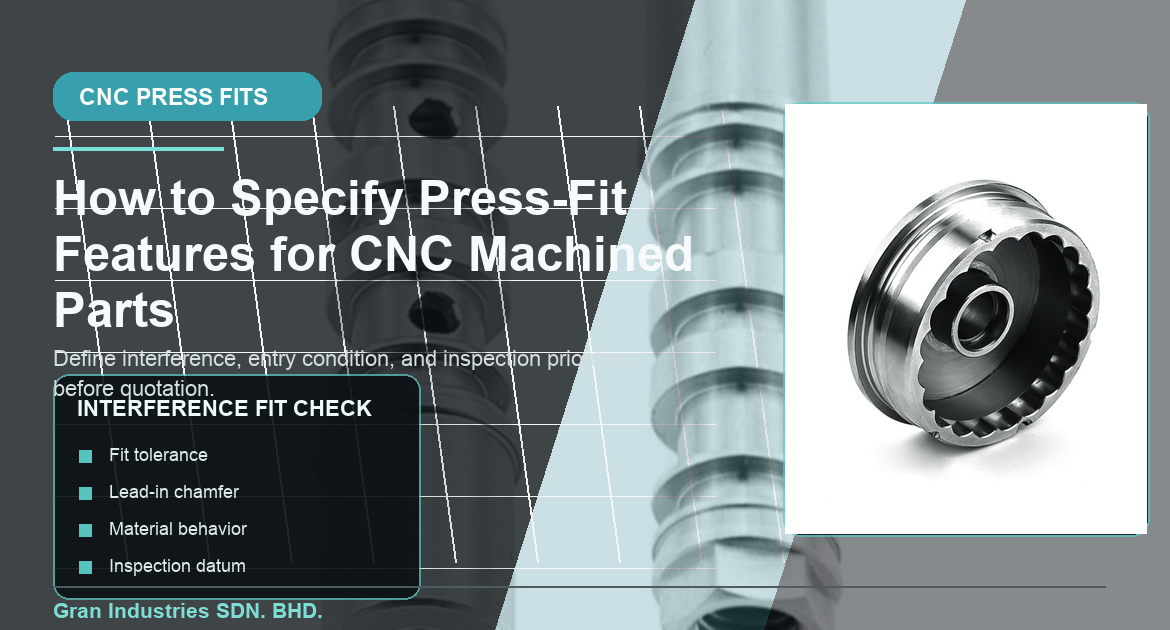
Press-fit features are common in CNC machined parts because many assemblies rely on controlled interference between two components instead of adhesives, threads, or separate retention hardware. Bushings, pins, sleeves, bearings, inserts, and alignment components may all depend on a press-fit relationship. The challenge is that a press fit is not defined by one diameter alone. It depends on the mating materials, tolerance strategy, surface finish, lead-in geometry, and the assembly method that will be used later.
That is why press-fit features often cause avoidable problems when the drawing only lists a nominal hole size or shaft size and leaves the rest to assumption. A fit that is too loose may fail in service. A fit that is too tight may damage the part during assembly or create distortion around nearby features. Even when the nominal dimensions look simple, the actual manufacturing requirement is a system-level fit relationship.
At Gran Industries, press-fit review is part of the broader drawing-review process for custom CNC machined parts. The goal is to define the fit in a way that supports repeatable machining, practical inspection, and stable downstream assembly before quotation begins.
Start with the assembly function of the fit
A press-fit feature should always be tied to the job the assembly needs to do. One fit may retain a pin in position. Another may hold a bearing outer ring, an insert, or a bushing in a housing. Some fits must resist rotation. Others mainly prevent axial movement. Some parts are assembled once, while others may need controlled service replacement. Those differences affect how the feature should be specified and how conservative the fit should be.
Before quotation, it helps to clarify:
- Which component is intended to be retained by interference
- Whether the fit is permanent, semi-permanent, or serviceable
- Whether the retained component must resist rotation, pull-out, or both
- Whether the fit sits near thin walls, pockets, or other critical geometry
- Whether assembly happens by manual press, thermal method, arbor press, or fixture-assisted process
This prevents the supplier from treating the fit as only a nominal dimension instead of an assembly-critical feature pair.
Why press-fit details affect CNC machining quotes
Press-fit features can affect tool selection, tolerance control, finishing approach, and inspection effort. A simple bore may not be enough if the fit depends on a tight diameter range, controlled roundness, a specific surface condition, or a precise relationship to datums and nearby features. If the RFQ does not make those priorities clear, the supplier may either quote conservatively or return with clarification questions before production can begin.
This is why press-fit features should be reviewed during drawing review before CNC machining quotes and production. Even small fit features can change the machining route if the part needs extra control on bores, shoulders, or the surrounding support geometry.
Closer review is usually warranted when the part includes:
- Interference fits in thin-wall housings
- Press-fit bores near slots, grooves, or pockets
- Bearing or bushing seats with rotation-resistance requirements
- Pins or sleeves located by datum-critical hole positions
- Fit features combined with coatings or post-machining finishing
- Assemblies where installation force matters to production flow
Do not specify only one side of the fit without context
A press fit is defined by the relationship between the mating parts, not by the housing or shaft alone. If only one side of the fit is specified clearly, the supplier may not know how much interference is actually intended. That matters even more when the mating component is purchased from another source, because the machined part still needs to match the real incoming component range instead of an ideal nominal size.
A stronger RFQ normally clarifies:
- Which part dimension is controlled by the machining supplier
- What tolerance range the mating component is expected to follow
- Whether the fit requirement is based on a known standard or internal design target
- Whether assembly force or retention force is more critical
- Whether temperature or service conditions affect the fit choice
That information helps the supplier understand the real manufacturing target instead of machining toward an incomplete nominal dimension.
Material behavior changes the fit strategy
Interference that works in one material combination may be too aggressive or too weak in another. Aluminum housings respond differently from stainless steel parts. Copper alloys, engineering plastics, and carbon fiber structures each bring different concerns for local deformation, edge stability, or long-term retention. The same nominal interference cannot be assumed to behave identically across every material pair.
That is why fit planning should remain connected to material selection. Projects involving aluminum alloy CNC processing, stainless steel CNC machining, copper and copper-alloy machining, engineering plastic machining, or carbon fiber processing should not assume that a single interference rule applies equally well in every case.
If the surrounding part geometry is light or pocketed, the same reasoning also overlaps with thin-wall feature planning and pocket-depth review, because the fit may change local part stiffness during pressing.
Lead-ins, chamfers, and entry conditions still matter
Many press-fit problems happen not at the final seated position, but during assembly entry. A controlled lead-in chamfer can help align the component and reduce damage risk. If the bore edge is too sharp, burrs or local deformation can interfere with insertion. If the lead-in is too large, it may change how the fit begins or reduce the useful contact length unexpectedly.
This is why fit features should be reviewed together with chamfers and radii and edge-break and deburring requirements. The entry condition is often a functional part of the fit, not just cosmetic finishing.
Surface finish and bore condition can affect assembly consistency
Press fits are not only about size. Surface finish, local chatter marks, burrs, and bore condition can influence assembly force and retention behavior. A feature may measure correctly but still assemble inconsistently if the surface condition varies too much from part to part. In some cases, the finish on the bore or shaft matters almost as much as the nominal interference range.
If the fit is function-critical, the drawing should clarify whether the key requirement includes:
- Controlled bore finish
- Roundness or cylindricity expectations
- Edge condition at entry and exit
- Surface treatment timing relative to fit control
- Restrictions on burrs or local damage near the seat
This also connects to surface finish planning when the fit depends on predictable contact behavior across a machined bore or shaft.
Datums and surrounding geometry can be as important as the fit diameter
A press-fit bore may retain a component, but it may also locate that component relative to mounting faces, precision holes, cover features, or rotating parts. If the fit controls alignment as well as retention, then its position to datums matters, not just its diameter. The same is true when a press-fit pin or sleeve controls assembly location in addition to being held in place.
Useful clarification points include:
- Which datum face or hole pattern locates the fit
- Whether concentricity or positional control matters to assembly
- Whether a nearby shoulder or step defines the seated stop
- Whether the fit must remain stable under clamp load or fastening load
- Whether the press-fit feature interacts with sealing, rotating, or sliding surfaces
This is especially relevant when the fit sits near precision holes, groove features, or cover interfaces that depend on alignment after assembly.
Inspection should match the real fit risk
Some press-fit features only need dimensional confirmation. Others need tighter focus on bore control, entry condition, and surrounding geometry. If the fit is critical to product function, the inspection plan should reflect that instead of treating the feature like a standard noncritical hole.
Inspection planning should clarify:
- Which dimensions determine acceptance
- Whether the bore or shaft needs additional geometric checks
- Whether entry-edge condition or finish must be reviewed
- Which datum references should be used during measurement
- Whether the feature belongs in first article inspection
This keeps inspection effort focused on the part of the feature that actually affects assembly success.
What to include in an RFQ when press-fit features matter
For custom CNC machined parts with interference-fit features, the quotation package is usually stronger when it includes:
- 2D drawing and 3D model when available
- Definition of the mating component and fit purpose
- Controlled bore or shaft tolerance information
- Material grade and any relevant finishing requirements
- Lead-in, chamfer, or entry-edge requirements
- Nearby geometry or wall-thickness conditions that affect pressing
- Assembly method or load expectations when known
- Inspection or first article requirements tied to fit performance
That information lets the supplier quote the feature as a real assembly requirement instead of only a nominal diameter on the drawing.
Clear press-fit notes support better CNC machined parts
Press-fit features may look compact on a drawing, but they often determine how consistently parts assemble and how reliably components stay retained in use. When interference, material behavior, entry condition, and inspection priorities are defined clearly, the machining route becomes more predictable and downstream assembly risk becomes easier to control.
If your custom CNC machined part includes press-fit bores, pins, sleeves, bushings, or bearing seats, Gran Industries can review the drawing, material, tolerance approach, and production intent before quotation. You can also send your project details for review when you are ready.