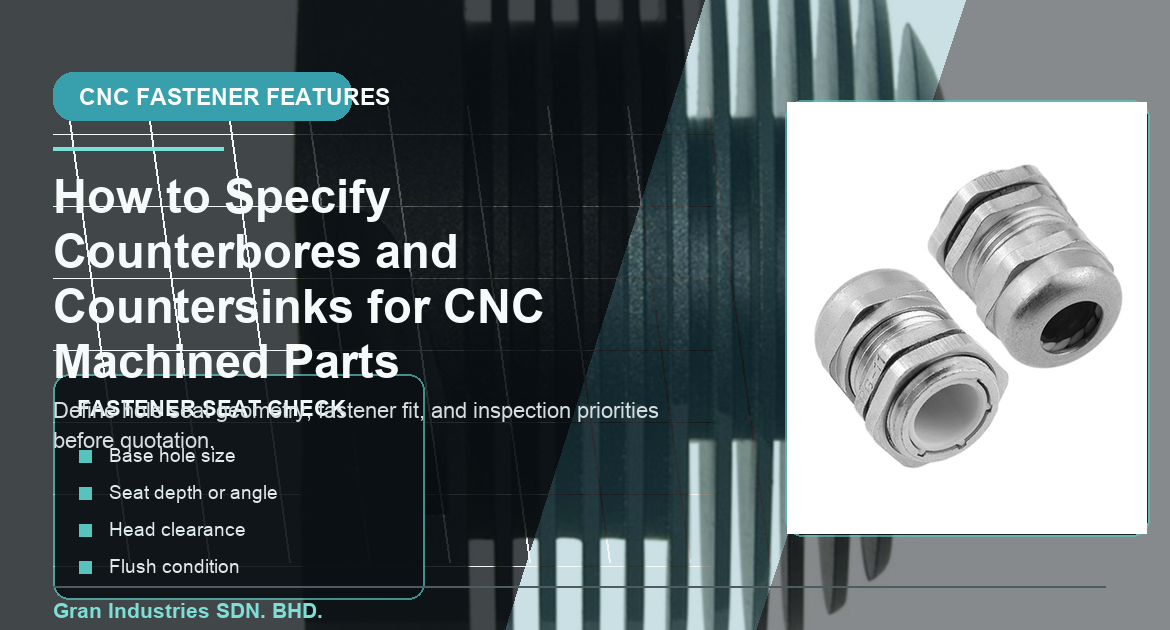
Counterbores and countersinks are common features in CNC machined parts because many assemblies rely on fasteners that need controlled seating, clearance, or flush mounting. These features may look simple on a drawing, but they often create preventable problems when the geometry is incomplete or the design intent is not clearly stated. A hole size without the right head clearance, a countersink without the correct included angle, or a counterbore without a controlled depth can all cause assembly issues later.
The challenge is that these features do more than modify a hole. They define how a screw head seats, how load transfers into the part, whether a component sits flush, and how much clearance remains around a tool or mating feature. If the drawing does not separate critical dimensions from general geometry, the supplier may have to make assumptions during quotation and process planning.
At Gran Industries, counterbore and countersink review is part of the broader drawing-review process for custom CNC machined parts. The practical goal is to understand what the fastener needs to do, how the feature relates to the rest of the part, and which dimensions actually determine acceptance before machining begins.
Start with the fastener and the assembly function
A counterbore or countersink should be specified around the fastener and the assembly purpose, not only around the cut feature itself. A socket-head cap screw may need enough counterbore diameter for head clearance and tool access. A flat-head screw may need a countersink angle that matches the screw standard and a depth that supports the intended flush condition. In some parts, the feature only provides head clearance. In others, it controls alignment, top-surface condition, or the relationship between stacked components.
Before quotation, it helps to clarify:
- Which fastener standard and size the part uses
- Whether the screw head must sit below flush, flush, or slightly proud
- Whether the feature is purely for clearance or also for appearance
- Whether the head seating surface needs a controlled finish or flatness
- Whether the feature affects gasket contact, cover fit, or nearby components
This keeps the RFQ focused on the function of the feature rather than relying on nominal geometry alone to communicate intent.
Why these features affect CNC machining quotes
Counterbores and countersinks influence tool selection, setup order, inspection method, and sometimes the part orientation used during machining. A head-clearance feature on an open face may be straightforward. A countersink on an angled or finished face, or a counterbore near a wall, may require more careful tool access and positioning. If the drawing is incomplete, the supplier may need to price conservatively or return with clarification questions.
This is why these details should be reviewed during drawing review before CNC machining quotes and production. Even small fastener features can affect whether a part assembles cleanly, whether the correct tool can reach the screw, and whether the visible surface looks finished when the product is complete.
Counterbores and countersinks typically deserve closer review when the part includes:
- Flush or near-flush fastener requirements
- Thin surrounding material
- Fastener features near slots, pockets, or edges
- Cosmetic top faces with visible screw heads
- Sealing or gasket surfaces around the fastener zone
- High-density hole patterns or limited tool access
Do not separate the modified feature from the base hole
A counterbore or countersink is only part of the overall hole specification. The base hole size, fit, and location still matter, and the modified head-seating feature needs to be understood as part of the same assembly requirement. If the hole is for clearance, the relationship between the shank clearance and the head seat matters. If the hole is threaded from one side and counterbored from the other, the drawing should make that structure clear instead of leaving the supplier to infer the machining order.
A strong drawing usually clarifies:
- The base hole diameter and function
- The counterbore diameter and depth, or the countersink diameter and angle
- Whether the head seat must align to a datum face
- Whether the feature is through, blind, or part of a multi-step hole
- Whether the fastener must sit flush relative to the final surface condition
This prevents the feature from being interpreted as an isolated cut rather than an assembly-critical hole system.
Counterbore depth and countersink angle are usually function-critical
Counterbore depth often controls whether the screw head clears the surface, whether a washer fits, or whether enough wall thickness remains under the head. Countersink angle determines whether the screw head seats correctly. A mismatch between the screw standard and the machined angle can create unstable seating or visible assembly defects even if the nominal diameter looks correct.
Useful clarification points include:
- Required head clearance above or below the surface
- Acceptable flush condition tolerance
- Included angle for the countersink
- Whether the seating area must be free of burrs or heavy tool marks
- Whether the dimension applies before or after finishing or coating
If the countersink or counterbore sits on a visible or sealing face, the surface condition around the feature may matter almost as much as the diameter itself.
Location to datums and nearby features can matter more than the head seat alone
Some counterbores and countersinks mainly provide screw-head clearance. Others must align precisely with mating holes, cover plates, or clamped components. In those cases, the modified feature should not be treated as only a local surface cut. Its position relative to datum faces, hole patterns, or surrounding geometry can be more important than the head seat viewed by itself.
This is particularly relevant when the feature sits near precision holes, slots, or narrow margins. If the fastener feature also contributes to alignment or stack-up control, the drawing should identify that relationship clearly so machining and inspection can follow the right references.
Thin material and pocketed areas need extra review
Counterbores and countersinks can become more sensitive when they are placed in thin sections, above pockets, or near deep cavities. A counterbore may remove more supporting material than expected. A countersink may reduce the remaining surface thickness around a hole edge. In pocketed components or thin-wall parts, these features can change local stiffness and affect how the part responds during machining and assembly.
That is why these features often overlap with concerns seen in thin-wall CNC machined parts and pocket-depth planning. The drawing should make it clear if the minimum remaining wall or floor thickness matters around the fastener zone.
Surface finish and burr control should be tied to the feature
Fastener seating surfaces are often affected by burrs, edge condition, and local surface finish. A countersink on a visible face may need a cleaner edge than a hidden internal feature. A counterbore under a socket-head screw may need a clean bottom and sidewall so the head seats evenly. If these expectations are important, the drawing should tie them to the actual feature instead of relying on a general deburring note.
This connects directly to surface finish planning and edge break and deburring requirements for CNC machined parts. The fastener feature should not be treated as only a dimensional cut if its seating condition affects assembly quality.
Material choice can affect feature quality and repeatability
Different materials respond differently to head-seating features. Aluminum may machine efficiently, but thin margins or cosmetic surfaces may still need careful handling. Stainless steel may require more control around tool pressure and finish. Copper alloys can behave differently at edges. Engineering plastics may need attention to support and heat. Carbon fiber parts bring separate concerns around edge stability and local breakout control.
That is why counterbore and countersink strategy should remain connected to material selection. Projects involving aluminum alloy CNC processing, stainless steel CNC machining, copper and copper-alloy machining, engineering plastic machining, or carbon fiber processing should not assume the same head-seating detail behaves the same way in every material family.
Inspection should focus on fastener fit and acceptance, not only nominal geometry
Counterbores and countersinks can be measured dimensionally, but inspection should stay tied to function. In some parts, a diameter and depth check is enough. In others, the important question is whether the intended screw seats correctly, reaches the correct flush condition, and aligns to the rest of the assembly without interference.
Inspection planning should clarify:
- Which dimensions determine acceptance
- Whether flush condition is part of the requirement
- Which datum reference controls the feature position
- Whether the seat surface condition needs evaluation
- Whether the feature belongs in first article inspection
This keeps the inspection effort aligned with how the fastener feature functions in the finished product.
What to include in an RFQ when counterbores or countersinks matter
For custom CNC machined parts with head-seating features, the quotation package is usually stronger when it includes:
- 2D drawing and 3D model when available
- Fastener standard and size
- Base hole size and function
- Counterbore diameter and depth, or countersink diameter and angle
- Expected flush condition or head clearance
- Material grade and order quantity
- Surface finish or deburring notes tied to the feature
- Inspection or first article requirements related to fastener seating
That information helps the supplier review the feature as part of a real assembly requirement instead of just a modified hole on the drawing.
Clear fastener-seat specifications support better machining outcomes
Counterbores and countersinks can look minor on a drawing, but they often control fastener fit, top-surface condition, local wall thickness, and visible assembly quality. When the fastener type, seat geometry, datums, and finish expectations are clear, the quotation becomes more accurate and the machining process becomes more predictable.
If your custom CNC machined part includes socket-head or flat-head fastener features, Gran Industries can review the drawing, material, tolerance approach, and production intent before quotation. You can also send your project details for review when you are ready.