
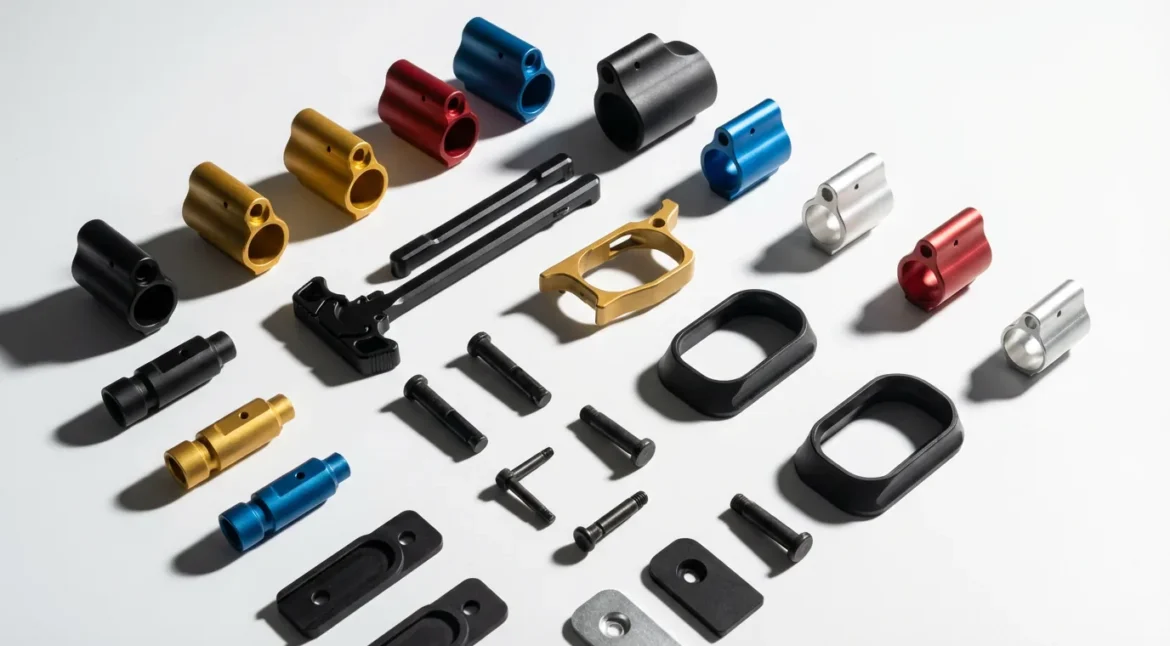
In the AR15 platform, the gas block is the heart of the cycling system. It redirects high-pressure gas from the barrel into the gas tube to drive the bolt carrier group. For OEM brands and designers, achieving the correct machining tolerances on this component is the difference between a reliable, flat-shooting rifle and a platform plagued by cycling failures, gas leaks, or premature erosion.
\n
Precision machining of gas blocks—whether low-profile, adjustable, or A2 style—requires a deep understanding of the barrel interface and the extreme thermal environment the part inhabits. This guide details the critical tolerances and manufacturing standards for high-performance AR15 gas blocks.
\n
\n
1. The Primary Interface: Bore Diameter Precision
\n
The most critical dimension of any gas block is the inner diameter (ID) of the bore that slides over the barrel. Most AR15 barrels have a gas block journal diameter of 0.750\”, 0.625\” (pencil profiles), or 0.875\” / 0.936\” (heavy profiles).
\n
Tolerance Standard:
\n
- \n
- Target ID: Journal Diameter + 0.001\”
- Tolerance: +0.001\” / -0.000\”
\n
\n
\n
A \”slip-fit\” is the goal. If the bore is too tight (under 0.0005\” clearance), the block may gall or seize during installation. If too loose (over 0.002\” clearance), gas will leak between the barrel and the block, leading to \”short stroking\” and carbon fouling on the barrel exterior.
\n
Machining Note: Reaming vs. Boring
\n
To achieve this level of consistency across a production run, we recommend finish-reaming the bore. A precision reamer ensures better circularity and surface finish (typically 32 Ra or better) compared to standard boring operations, providing a superior gas seal.
\n
\n
2. Gas Port Alignment and Dimensions
\n
The gas port in the block must align perfectly with the hole in the barrel. Even a minor misalignment restricts gas flow and creates turbulence.
\n
- \n
- Hole Diameter: Typically 0.125\” (standard). This is larger than the barrel gas port to allow for slight longitudinal stack-up error.
- Positional Tolerance: +/-0.005\” relative to the rear face of the gas block.
- Angular Tolerance: The gas port must be perfectly centered (0° offset) relative to the vertical axis of the block.
\n
\n
\n
\n
\n
3. Gas Tube Bore and Alignment
\n
The hole that receives the gas tube must be concentric and correctly depth-controlled. If the tube is forced at an angle, it will cause excessive friction with the gas key on the bolt carrier.
\n
- \n
- Bore Diameter: 0.180\” +0.002\” / -0.000\”.
- Roll Pin Hole: Must be precisely located to secure the gas tube without preventing it from slightly \”floating\” to accommodate heat expansion.
\n
\n
\n
\n
4. Set Screw vs. Pinning: Mounting Considerations
\n
OEMs must decide between set-screw mounting and cross-pinning.
\n
- \n
- Set-Screw Blocks: Require precisely tapped 10-32 or 8-32 holes. We recommend machining a flat or \”dimple\” on the bottom of the barrel to ensure the screws don’t migrate under recoil.
- Pinned Blocks: Require a cross-bore for a 1/8\” or 5/32\” taper pin. This is the most secure method but requires higher setup precision during final assembly.
\n
\n
\n
\n
5. Material and Heat Treatment
\n
Gas blocks are subjected to blast-furnace temperatures and abrasive carbon particles. Material choice is as important as the dimensions.
\n
- \n
- 4140 Chromoly Steel: The industry standard. Must be heat-treated to 28-32 HRC to prevent the gas port from \”eroding\” over time (widening due to gas cutting).
- 17-4 PH Stainless Steel: Excellent for high-heat and corrosion resistance. Often left in a matte finish or Nitrided.
- Surface Finish: Black Nitride (QPQ) or Manganese Phosphate are preferred to increase surface hardness and corrosion resistance.
\n
\n
\n
\n
\n
6. DFM Tips for OEM Designers
\n
- \n
- Chamfer the Bore: A 0.030\” x 45° chamfer on both ends of the main bore prevents \”catching\” on the barrel journal during assembly.
- Reduce Mass: For modern \”lightweight\” builds, use CNC contouring to remove non-structural material around the gas tube housing.
- Interference Check: Ensure the gas block profile clears the inner diameter of common M-LOK handguards (typically 1.3\” to 1.5\”).
\n
\n
\n
\n
\n
Partner with a Precision Manufacturer
\n
At Gran.my, our Airsoft & Rifle Accessory Parts Machining division understands that +/-0.001\” matters. We use high-precision 4-axis and 5-axis CNC centers to ensure that every gas block, charging handle, and receiver component meets your exact specifications.
\n