The airsoft and tactical accessory market has evolved significantly over the past decade. What started as simple plastic upgrades has grown into a sophisticated industry where players and brand owners demand premium materials, tight tolerances, and flawless aesthetics.
For anyone designing custom magwells, slide plates, gas blocks, or charging handles, one of the most critical early decisions is choosing the right manufacturing method. The two most common approaches are die-casting and CNC machining — and the difference in quality between them is immediately apparent to anyone who has handled both.
This guide breaks down the technical, aesthetic, and economic differences between die-casting and CNC machining for airsoft and rifle accessories, helping OEMs and designers choose the process that aligns with their brand’s quality standards.
Understanding the Two Manufacturing Methods
Die-Casting: The High-Volume, Lower-Cost Option
Die-casting involves injecting molten aluminum (or zinc) into a steel mold under high pressure. Once the metal cools, the mold opens and the part is ejected. This process is well-suited for producing very large quantities of identical parts quickly and at low per-unit cost.
Key Characteristics:
- High initial tooling cost (mold fabrication: $3,000 – $15,000+)
- Low per-part cost at high volumes
- Fast cycle times (seconds per part)
- Limited to simpler geometries
CNC Machining: The Precision, High-Quality Option
CNC machining starts with a solid block of aluminum (billet) and uses computer-controlled cutting tools to remove material until the final part shape is achieved. This subtractive process produces parts with superior structural integrity, tight tolerances, and excellent surface quality.
Key Characteristics:
- No tooling cost (program directly from CAD files)
- Higher per-part cost (offset by zero mold investment)
- Complex geometries and deep internal features
- Superior material properties from solid billet stock
Structural Integrity: Porosity vs Solid Billet
The Hidden Problem with Die-Cast Parts
One of the most significant weaknesses of die-casting is internal porosity. When molten metal is injected into a mold, tiny air bubbles become trapped inside the part. These voids are invisible from the outside but significantly weaken the part’s structure.
For airsoft accessories like slide plates or magwells, porosity means:
- Reduced impact resistance: A dropped gas block can crack or shatter along internal void lines.
- Poor thread engagement: Tapped threads in porous material strip more easily under torque.
- Anodizing defects: Surface pores cause uneven color absorption, resulting in blotchy or speckled finishes.
Why Billet CNC Parts Are Superior
CNC machined parts are cut from solid billet aluminum (typically 6061-T6 or 7075-T6). The material is dense, uniform, and completely free of internal voids. This means:
- Consistent strength throughout: The entire part has the same mechanical properties, with no weak spots.
- Reliable thread performance: Tapped holes in solid aluminum hold torque specifications consistently.
- Flawless anodizing: The dense, uniform surface absorbs anodizing evenly, producing vibrant and consistent colors.
Dimensional Accuracy and Tolerances
Die-Casting Tolerances: ±0.1mm to ±0.3mm
Die-cast parts are subject to dimensional variation caused by:
- Mold shrinkage: As the metal cools, it shrinks unpredictably depending on wall thickness and cooling rate.
- Mold wear: Over thousands of cycles, the steel mold erodes, causing part dimensions to drift.
- Ejection deformation: Parts can warp slightly during ejection from the mold.
For accessory parts that must fit precisely to platform specifications (such as a magwell seating perfectly into a GBB frame), ±0.2mm variation can mean the difference between a perfect fit and a frustrating assembly experience.
CNC Machining Tolerances: ±0.01mm
CNC machining holds significantly tighter tolerances. Modern CNC centers routinely achieve ±0.01mm (0.0004 inches), which is:
- 20x more precise than typical die-casting
- Ensures perfect platform compatibility every time
- Eliminates the need for manual filing or sanding during assembly
- Critical for gas block bores, pin holes, and threaded interfaces
For OEM brands building a reputation on quality, this level of consistency is non-negotiable.
Surface Finish and Aesthetic Quality
Die-Cast Surface Quality
Die-cast parts typically exhibit several surface imperfections that are difficult or impossible to eliminate:
- Parting lines: Visible seams where the two halves of the mold meet. These often require extensive post-casting grinding and polishing.
- Ejector pin marks: Small indentations where the pins push the part out of the mold.
- Surface roughness: Typical die-cast surface roughness (Ra 1.6 – 3.2 μm) is significantly rougher than machined surfaces.
- Porosity pits: Microscopic holes visible after anodizing, creating a speckled or “orange peel” appearance.
CNC Machined Surface Quality
CNC machined parts start with a smooth, uniform surface directly off the machine:
- No parting lines or ejector marks: The part is cut from solid stock, so there are no mold-related artifacts.
- Superior surface finish: Standard CNC surface roughness (Ra 0.4 – 0.8 μm) is 4-8x smoother than die-cast.
- Custom texturing: Features like serrations, stippling, and custom profiles are machined directly into the part with sharp, clean definition.
- Flawless anodizing base: The smooth, dense surface produces even, vibrant color anodizing with a professional, premium appearance.
Anodizing Comparison: The Visual Difference
For the tactical accessory market, anodizing quality is often the first thing a customer notices. The difference between die-cast and CNC parts becomes immediately apparent after anodizing.
Die-Cast Anodizing Results
The porous, uneven surface of die-cast aluminum causes several anodizing problems:
- Inconsistent color absorption: Porous areas absorb dye differently, creating blotchy or mottled patches.
- Limited color options: Lighter colors (silver, gold, rainbow) highlight surface defects, making them visibly unappealing.
- Durability issues: The anodized layer is weaker over porous areas and can chip or peel more easily.
CNC Anodizing Results
CNC machined parts from solid 6061-T6 billet produce exceptional anodizing results:
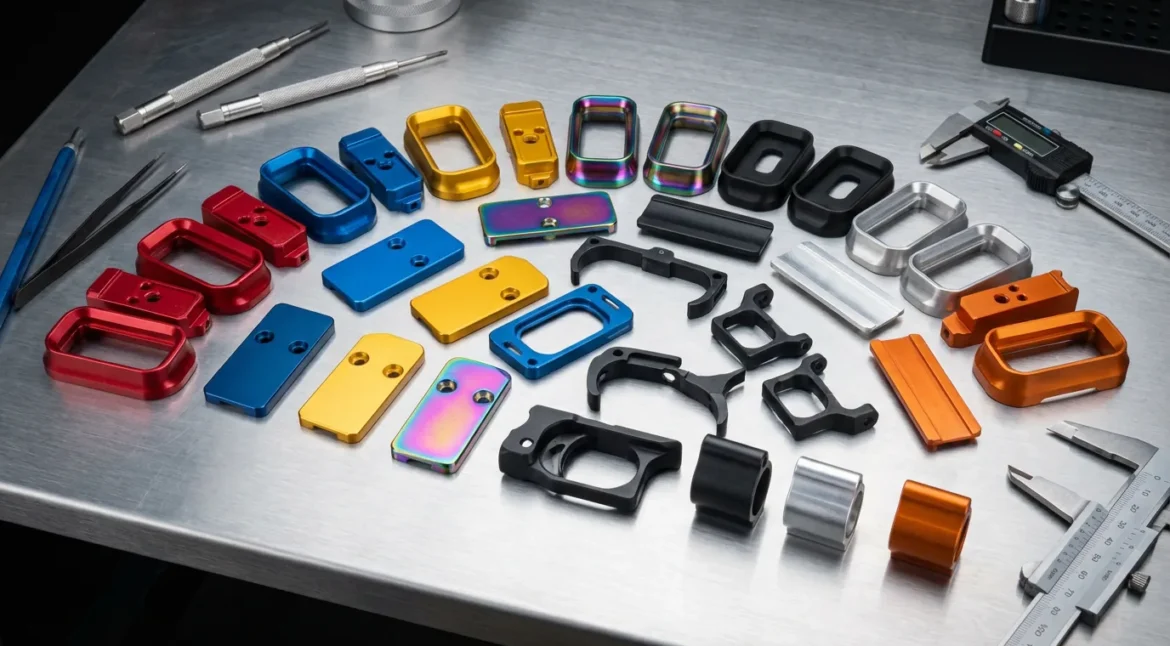
- Vibrant, uniform colors: Black, Silver, Red, Blue, Gold, Rainbow, and Orange all come out consistent and flawless.
- Type II (standard): Beautiful decorative finishes perfect for aesthetic accessories like magwells and slide plates.
- Type III (hardcoat): Thick, durable matte black finishes for functional parts like gas blocks and rail covers.
- Laser engraving contrast: The dense, uniform anodized layer produces crisp, high-contrast laser-engraved logos and text.
Cost Analysis: When Does CNC Make Economic Sense?
Many designers assume die-casting is always cheaper, but this isn’t true for most airsoft accessory production runs. Let’s break down the actual economics.
Die-Casting Cost Structure
| Item | Cost |
|---|---|
| Mold (tooling) | $3,000 – $15,000+ (one-time) |
| Per-part cost | $1 – $5 (depending on complexity) |
| Post-processing (deburring, grinding) | $0.50 – $2.00 per part |
| Scrap/rework rate | 5-15% of production |
CNC Machining Cost Structure
| Item | Cost |
|---|---|
| Programming/setup | $100 – $500 (one-time per part design) |
| Per-part cost | $5 – $25 (depending on complexity and quantity) |
| Post-processing | Minimal (light deburring only) |
| Scrap/rework rate | 1-3% of production |
Break-Even Analysis
For a typical magwell or slide plate design:
- Die-casting total cost for 500 parts: $3,000 (mold) + 500 × $3 (parts) + 500 × $1 (post-processing) = $5,000
- CNC machining total cost for 500 parts: $300 (programming) + 500 × $8 (parts) = $4,300
At 500 units, CNC machining is already cheaper — and the parts are significantly higher quality. The break-even point is typically between 200-500 parts, depending on part complexity.
For small to medium batch production (50-2,000 units), CNC machining almost always provides better value when quality is factored in.
Design Flexibility: Prototyping to Production
Die-Casting Limitations
- Design changes require new molds ($3,000 – $15,000 each)
- Lead time for new mold: 4-8 weeks
- Complex internal features (deep pockets, thin walls, undercuts) are difficult or impossible to cast
CNC Machining Advantages
- Design changes are as simple as updating the CAM program (hours, not weeks)
- First parts can be produced in 3-7 days from CAD
- Virtually any geometry is achievable, including complex internal channels and thin-walled features
- Ideal for rapid prototyping and iterative design development
For OEM brands developing new products, CNC machining enables faster time-to-market and lower risk during the design phase.
How Gran.my Supports OEM Accessory Brands
At Gran.my, our Airsoft & Rifle Accessory Parts Machining service is specifically tailored for brands and designers who need premium-quality, precision-machined components.
What we provide:
- Direct CAD-to-part manufacturing: Send your design files, and we produce precision parts in 6061 or 7075 aluminum, stainless steel, or titanium.
- Prototype to batch production: From 10 samples for fitment testing to 5,000+ unit production runs.
- Anodizing coordination: Type II and Type III anodizing in your choice of color, with laser engraving for branding.
- Design for manufacturability (DFM) review: Our engineers review your drawings and suggest optimizations to improve quality and reduce cost.
- Consistent quality control: Every batch inspected against your CAD specifications, ensuring your brand’s reputation for quality is maintained.
Whether you’re a startup launching your first custom magwell or an established brand expanding your product line with precision-machined accessories, Gran.my provides the manufacturing expertise and quality consistency you need.
Conclusion
Die-casting has its place in high-volume, cost-driven manufacturing. But for airsoft and tactical accessories where fitment, aesthetics, and brand reputation matter, CNC machining from solid billet aluminum is the clear choice.
The superior structural integrity, 20x tighter tolerances, flawless anodizing results, and lower total cost for small-to-medium batches make CNC machining the preferred process for serious accessory brands. At Gran.my, we specialize in bringing your CAD designs to life with the precision and finish quality that your customers will notice immediately.
Ready to manufacture your accessory designs? Send your drawings to Gran.my for a comprehensive manufacturing review and competitive quotation.