Aerospace manufacturing is defined by its uncompromising requirements for precision, reliability, and safety. In an industry where components must withstand extreme forces, temperature fluctuations, and weight constraints, there is zero margin for error. Aerospace CNC machining is the primary manufacturing process that delivers these critical parts, from structural airframe components to complex engine assemblies.
For aerospace engineers and procurement managers, choosing a manufacturing partner who understands these rigorous standards is essential. This guide explores the aerospace CNC machining process, the specialized materials involved, and the quality control protocols that ensure flight-readiness.
The Role of CNC Machining in Aerospace
Computer Numerical Control (CNC) machining is the standard for aerospace production because it offers the repeatable precision needed for complex geometries. Unlike traditional manufacturing methods, CNC machines follow programmed instructions to remove material from solid blocks with tolerances as tight as ±0.001 inches (and often much tighter for specialized components).
The aerospace industry relies on several types of CNC machining:
1. 5-Axis CNC Milling
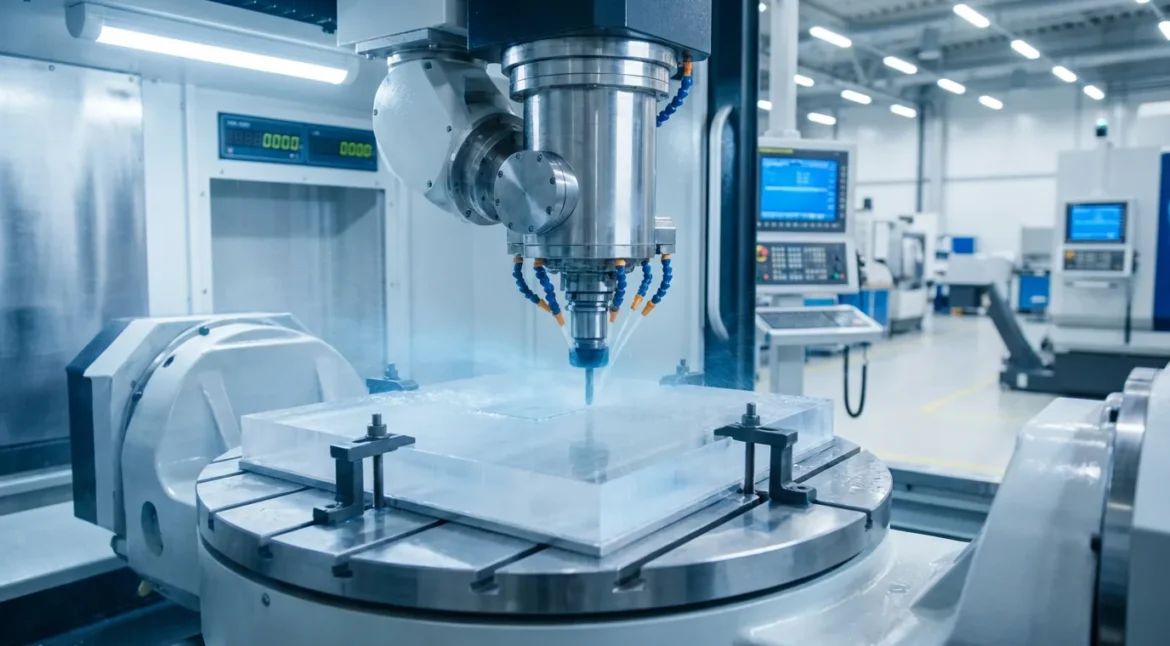
Many aerospace components feature complex curves and deep pockets to reduce weight while maintaining strength. 5-axis machines can approach the workpiece from any angle, allowing for the creation of intricate shapes in a single setup. This reduces handling errors and improves dimensional accuracy across the entire part.
2. CNC Turning and Swiss Machining
Engine components, landing gear pins, and specialized fasteners require high-precision rotational work. CNC lathes and Swiss-style machines are used to produce these cylindrical parts with exceptional surface finishes and tight diameter tolerances.
3. EDM (Electrical Discharge Machining)
For materials that are difficult to cut using traditional methods, such as heat-resistant superalloys (HRSA), EDM uses electrical sparks to erode material. This process is often used for creating complex internal cooling holes in turbine blades.
Specialized Materials for Aerospace Applications
Material selection is a critical stage in the aerospace CNC-Bearbeitungsverfahren. Every gram counts in aviation, and components must often resist corrosion and maintain structural integrity under high temperatures.
1. Titanium Alloys (e.g., Ti-6Al-4V)
Titanium is a staple of aerospace manufacturing. It offers a strength-to-weight ratio comparable to steel but at nearly 40% less weight. Titanium is also highly corrosion-resistant and retains its strength at high temperatures. However, it is difficult to machine due to its high strength and low thermal conductivity, requiring specialized tools and slower cutting speeds.
2. Aerospace-Grade Aluminum (e.g., 7075-T6, 6061-T6)
Aluminum remains the most common aerospace material due to its lightweight nature and excellent machinability. 7075-T6 aluminum is particularly popular for structural components because its strength is comparable to some steels while remaining much lighter.
3. Stainless Steel and Superalloys (e.g., Inconel 718, Hastelloy)
For components exposed to the extreme heat of jet engines, nickel-based superalloys like Inconel are used. These materials maintain their strength even when glowing red hot. Because they “work-harden” quickly during machining, they require advanced tool coatings and specific cutting strategies.
4. Carbon Fiber Composites
While often molded, carbon fiber components often require precision trimming and drilling via CNC machining. As discussed in our guide to carbon fiber processing, this material offers exceptional weight savings but requires specialized dust management and diamond-coated tools.
Critical Applications of Aerospace Machining
1. Structural Airframe Components
Wing spars, fuselage frames, and bulkhead brackets are the backbone of any aircraft. These large, complex parts are often machined from single blocks of aluminum or titanium to ensure maximum structural integrity and minimum weight.
2. Engine Assemblies
Jet engines are masterpieces of precision engineering. Components such as turbine blades, combustion chambers, and compressor disks must be machined to incredibly tight tolerances to ensure optimal airflow and fuel efficiency.
3. Landing Gear Components
Landing gear must withstand massive impact forces during landing. Actuators, shock struts, and wheel assemblies are machined from high-strength steels and titanium alloys to ensure they never fail under pressure.
4. Avionics and Interior Components
Electronic housings (EMI shielding), seat structures, and cockpit controls all require CNC machining. While these parts may not face the same structural stress as a wing spar, their precision is vital for the functional safety of the aircraft’s systems.
Challenges in Aerospace CNC Machining
1. Tight Tolerances
Aerospace parts often require tolerances that exceed standard commercial manufacturing. Achieving and maintaining these tolerances over a long production run requires high-precision machinery, thermal stability in the workshop, and experienced operators.
2. Material Cost and Waste
Materials like titanium and Inconel are expensive. In many aerospace projects, the “buy-to-fly” ratio (the weight of the raw material vs. the weight of the finished part) is high. Minimizing scrap through optimized CAM programming and precise setups is a key economic factor.
3. Heat Management
Machining hard aerospace alloys generates significant heat. If not managed properly, this heat can distort the part, cause tool failure, or even change the material’s properties. High-pressure through-spindle coolant and specific tool coatings are essential.
Quality Control and Certification
1. CMM (Coordinate Measuring Machine)
CMMs are the primary tool for verifying aerospace parts. These machines use sensitive probes to measure the part’s dimensions against the digital CAD model, ensuring every feature is exactly where it should be.
2. NDT (Non-Destructive Testing)
Techniques such as ultrasonic testing, X-ray inspection, and dye penetrant testing are used to detect internal cracks or surface flaws that aren’t visible to the naked eye.
3. Traceability
Every piece of material used in an aerospace project must have a documented history. Manufacturers must be able to trace a finished part back to the specific “heat” or batch of raw material it came from.
4. Industry Standards (AS9100)
AS9100 is the international quality management system standard for the aerospace industry. It builds upon ISO 9001 with additional requirements specifically focused on the safety and reliability needs of aviation and space.
Choosing an Aerospace Machining Partner
- Technical Expertise: Does the shop have experience with titanium and superalloys?
- Advanced Machinery: Do they have 5-axis capabilities for complex geometries?
- Quality Systems: Are they AS9100 certified or do they follow equivalent rigorous quality protocols?
- Prototyping to Production: Can they support initial design iterations and then scale to full production?
At Gran.my, our precision manufacturing services are designed to meet the demanding requirements of industrial and aerospace clients. From initial drawing review to final quality inspection, we ensure every component is manufactured to the highest standards.
Schlussfolgerung
Aerospace CNC machining is a high-stakes field that combines advanced technology, material science, and rigorous quality control. As aircraft designs continue to push the boundaries of performance and fuel efficiency, the demand for more precise and lightweight components will only grow.
Understanding the complexities of the aerospace manufacturing process helps engineers design better parts and enables procurement managers to select the most capable partners for their supply chain.