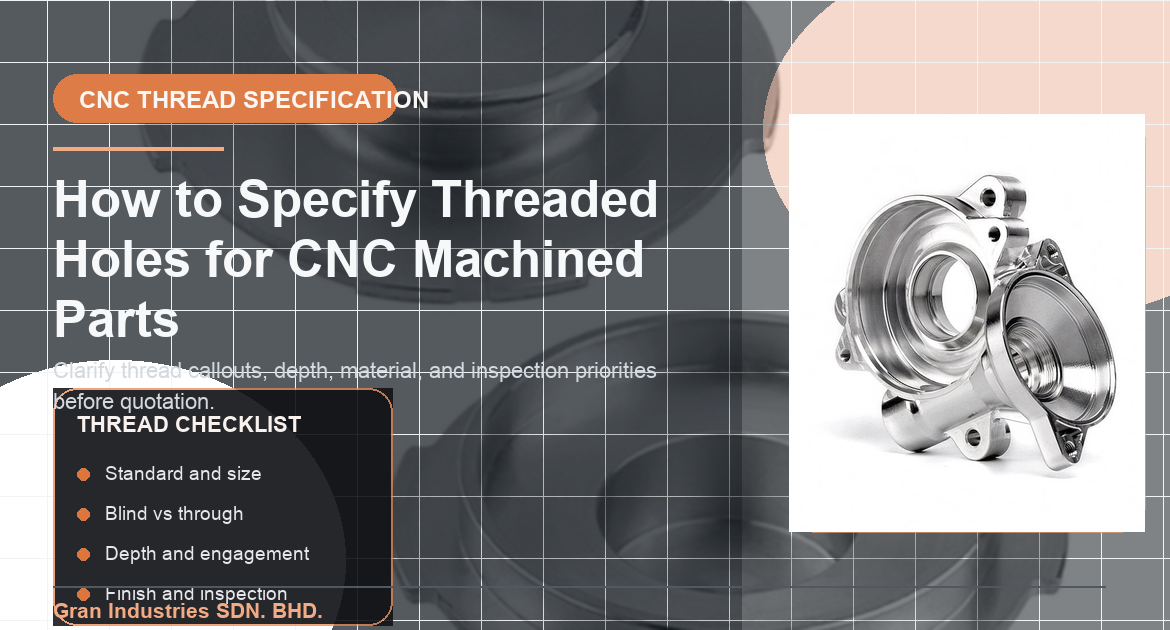
Threaded holes look simple on a drawing, but they often control how a custom part is assembled, serviced, and inspected after machining. A part may only have a few tapped features, yet those features can still affect tool choice, hole preparation, machining sequence, surface treatment planning, and the reliability of the final quote.
In practice, thread-related problems usually start before production. The drawing may show the thread size but leave the depth unclear. A blind hole may not explain usable thread engagement. A customer may require coating or anodizing but not note how that changes the final threaded condition. In other cases, a machined part includes multiple holes, counterbores, or tight feature relationships that make the thread detail more important than the outside shape of the part.
That is why thread callouts should be treated as part of drawing review rather than a small note to be interpreted later. At Gran Industries, the practical goal is to understand which threaded features are only standard fastening details and which ones are critical to assembly, repeat use, sealing, or alignment before quotation is finalized.
Why threaded holes deserve closer review before quotation
A tapped hole is not only a diameter with threads added. The quote and machining plan may also depend on hole depth, entry condition, bottom condition, material behavior, tool access, and whether the hole is tied to a more critical assembly relationship. When those details are unclear, the supplier may have to assume a process that does not fully match the real part requirement.
Important review points often include:
- Which thread standard and size are actually required
- Whether the hole is through or blind
- How much usable thread engagement the assembly really needs
- Whether countersinks, counterbores, spotfaces, or sealing faces relate to the threaded feature
- If the part material or finish changes how the thread should be produced
- Whether thread position is tied to a critical datum or mating pattern
This follows the same logic discussed in drawing review before CNC machining quotes and production. The clearer the thread detail is early, the more accurate the quotation and process planning become.
Start with a complete thread callout, not only nominal size
One of the most common quoting problems is a thread note that is only partly defined. A nominal size by itself may not be enough if the project also depends on pitch, series, tolerance class, or regional thread standard. Metric, UNC, UNF, BSP, and other thread systems should not be left to assumption when the part is intended for a specific market or mating component.
A stronger drawing package typically makes it easy to confirm:
- The thread designation and standard
- Pitch or thread series where relevant
- Quantity of threaded holes
- Whether the thread is internal, external, or paired with an insert
- Any fit requirement or assembly sensitivity linked to the threaded feature
Even when the thread itself is standard, the assembly intent may not be. If the feature is part of a repeating fastener pattern, a clamp point, or a sealing connection, that should be understood at quote stage rather than discovered later.
Blind holes need clear thread depth and bottom-condition notes
Blind threaded holes often create confusion because the drawing may show total hole depth but not the effective thread depth required for the fastener. Those are not always the same thing. The machining team needs to understand whether the design requires a certain number of engaged threads, extra drill depth below the tap, or a bottom form that affects tool choice and chip control.
A useful blind-hole specification usually clarifies:
- Total drilled depth
- Required threaded depth or minimum usable engagement
- Whether bottom clearance is needed below the thread
- Whether the hole is close to a thin wall, sealing face, or outside surface
- If bottoming taps or special access conditions are part of the requirement
This matters because blind threads can affect cycle planning, tool approach, and inspection. If the part also includes tight positional requirements, the thread feature may influence setup decisions more than the drawing suggests at first glance.
Threaded features should be reviewed together with the part material
Thread quality is shaped partly by material choice. A simple fastening feature in aluminum may not present the same production considerations as the same callout in stainless steel, copper alloy, or engineering plastic. Material selection changes how practical the machining route will be, how the thread holds up in use, and whether inserts or other reinforcement methods should be considered.
That is one reason material and thread review should stay connected. Customers planning aluminum alloy CNC parts, stainless steel machined parts, o engineering plastic components should not assume the same thread approach fits every material equally well. The part’s function, fastening frequency, and assembly load should all be considered before quotation.
For some custom parts, the best question is not only “what thread size is needed?” but also “what thread method is appropriate for this material and use condition?” That helps avoid oversimplifying the drawing package.
Counterbores, spotfaces, and sealing surfaces can change the real scope
Many threaded holes are part of a larger fastening feature rather than an isolated tap. The part may include a counterbore for bolt-head clearance, a countersink for seating, a spotface on a rough surface, or a local sealing face that must stay controlled around the threaded opening. Those related features should be reviewed together because they change both machining scope and inspection logic.
A better quotation request often makes it clear when the threaded feature is combined with:
- Counterbores or countersinks for hardware seating
- Spotfaces that need perpendicular or flat contact
- Gasket or sealing surfaces near the thread location
- Close spacing to edges, ribs, or other holes
- Fastener patterns that rely on positional consistency
Esto es similar a la forma en que tight tolerances affect CNC machining cost and inspection planning. The challenge is often not one single feature, but the relationship between several features that must work together after machining.
Finishing and coating requirements should be considered before threads are machined
Thread planning should also account for what happens after the machining step. If a part will be anodized, plated, passivated, coated, or prepared for a cleaner cosmetic finish, the threaded areas may need special review. The purpose is not to make the drawing more complicated than necessary. It is to prevent thread quality and finish expectations from being treated as separate decisions when they influence one another.
This can be especially important when the part has visible faces, sealing zones, or hardware that must seat cleanly after finishing. As covered in surface finish planning for CNC machined parts, finish expectations change process planning. Threaded features are part of that discussion when the final assembly depends on them.
Inspection should focus on the threaded features that actually matter
Not every threaded hole needs the same level of control. Some are general fastening points. Others determine alignment, clamping consistency, sealing reliability, or repeat service performance. The drawing and RFQ become more useful when they identify which threaded features are critical and which can follow normal production control.
Useful inspection-related notes may include:
- Threads tied to assembly datums or pattern position
- Fastener locations near critical bores, seats, or sealing faces
- Any thread that will be used repeatedly during maintenance or adjustment
- Hole features that require cleaner gauge acceptance or closer production monitoring
- Which dimensions around the threaded area matter more than the thread alone
This is closely related to first article inspection in CNC machining quality control. Once the threaded features that truly matter are identified early, inspection effort can stay aligned with actual assembly risk.
What to send when your part includes threaded holes
For CNC machined parts with threaded features, the strongest quotation package usually includes:
- 2D drawing and 3D file when available
- Complete thread callouts with standard, size, and depth information
- Notes showing whether holes are blind or through
- Any counterbore, countersink, spotface, or sealing requirement around the thread
- Material direction and any expected finish or coating
- Quantity for prototype and repeat orders
- Clear indication of which threaded features are critical in assembly
When those points are included, the supplier can review the part as a real manufacturing job rather than a generic tap note on a drawing. That usually leads to a more dependable quote and a smoother transition into production.
Clearer thread specifications support better CNC machining outcomes
Threaded holes may be small features, but they often carry a large share of the assembly risk in custom machined parts. Complete thread callouts, realistic depth notes, material-aware planning, and clearer inspection priorities all help quotation and production stay aligned from the beginning.
If your custom part includes tapped holes, blind threads, threaded patterns, or fastening features tied to sealing and alignment, Gran Industries can review the drawing and manufacturing approach before quotation. You can also send your project details here to discuss part geometry, material, quantity, and thread-related production requirements.