Bearing seats and bearing bores are small areas of a machined part, but they often determine whether a rotating assembly runs smoothly, holds alignment, and survives normal service loads. Housings, shafts, rollers, pulleys, fixtures, and motion components may all depend on bearing fits that look simple on a drawing but require careful machining control.
The risk is that a bearing feature is not just a hole or a turned diameter. It is a functional interface between the machined part and a purchased bearing. If the drawing does not define fit intent, shoulder geometry, surface finish, datum relationships, and inspection expectations, the supplier may quote the feature as ordinary geometry instead of a controlled bearing location.
At Gran Industries, bearing-seat review is part of the broader CNC drawing review process. The goal is to make the bearing interface clear before quotation, so the machining plan, inspection method, and assembly expectation all point to the same functional requirement.
Start by defining what the bearing must control
A bearing seat may control radial location, axial location, rotational accuracy, load transfer, or service replacement. These jobs are different. A shaft seat for an inner bearing race may need a different fit approach than a housing bore for an outer race. A locating shoulder may be more important in one assembly than the nominal bore diameter alone.
Before quotation, clarify:
- Whether the bearing supports rotation, alignment, load, or all three
- Whether the bearing is mounted on a shaft, inside a housing, or in a carrier
- Which bearing race should be fixed and which may need easier assembly
- Whether the part must allow service replacement
- Whether thermal growth, load direction, or vibration affects the fit choice
This turns a generic diameter into a bearing interface with a clear functional role.
Fit intent should be visible on the drawing
Bearing features often fail in communication before they fail in machining. A drawing may show a diameter and tolerance, but not explain whether the intended condition is slip fit, transition fit, press fit, or another controlled assembly condition. Without that context, the supplier may not know how much risk is attached to a small deviation.
This is similar to other fit-sensitive features such as press-fit features for CNC machined parts. The difference is that bearing seats also need attention to runout, shoulder support, surface condition, and assembly sequence.
A stronger RFQ usually states:
- The bearing part number or standard size when known
- The intended fit for the shaft seat or housing bore
- Which diameter is critical to bearing performance
- Whether assembly should be hand-fit, slip-fit, or pressed
- Whether the bearing may be removed during service
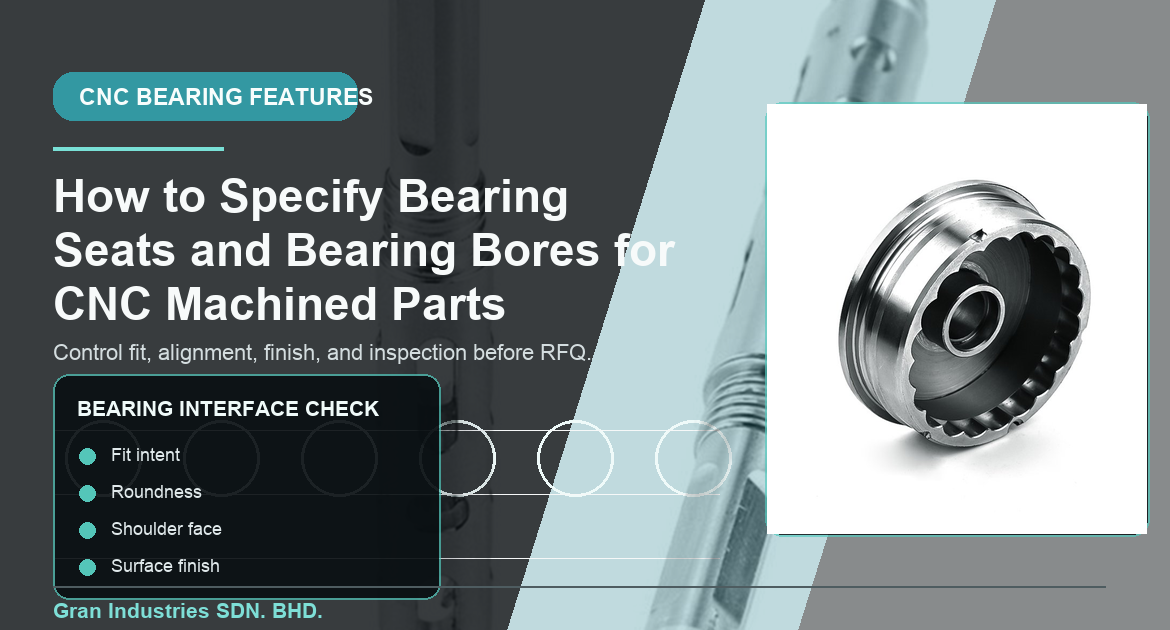
Roundness, cylindricity, and runout may matter more than a single size
A bearing can meet a nominal diameter requirement and still perform poorly if the seat is out of round, tapered, or misaligned with the working axis. For high-risk rotating parts, the drawing should not rely only on a plus-minus diameter tolerance when the actual risk is geometric.
Relevant controls may include:
- Roundness or cylindricity of the bearing seat
- Runout relative to the shaft or bore axis
- Perpendicularity of the bearing shoulder face
- Concentricity between multiple bearing locations
- Alignment between the bearing bore and nearby locating features
This is why bearing seats should be reviewed alongside precision holes, dowel features, and other datum-sensitive geometry before quoting.
Shoulders and reliefs affect seating and assembly
A bearing seat usually needs more than a controlled diameter. The bearing may need a shoulder for axial location, a relief to avoid radius interference, or an entry condition that prevents damage during assembly. If these details are left implicit, the part may be technically machinable but awkward or unreliable to assemble.
Useful details include:
- Shoulder height and bearing contact face
- Corner relief where the bearing race meets a shoulder
- Lead-in chamfer for assembly
- Clearance for tools, retaining rings, spacers, or seals
- Whether the bearing must seat fully against a defined face
These requirements connect directly to chamfer and radius planning and relief features for CNC machined parts.
Surface finish should match the bearing interface
Surface finish can influence assembly feel, bearing seating, wear behavior, and the stability of a controlled fit. A general surface-finish note may not be enough when the bearing seat is functionally different from the rest of the part. The drawing should identify whether the bearing diameter or shoulder face needs a tighter finish requirement.
This matters across different material families. Aluminum housings, stainless shafts, copper-alloy components, and engineering plastic carriers can each respond differently to tight bearing fits. For projects involving aluminum alloy CNC processing, stainless steel CNC machining, or engineering plastic machining, fit and finish expectations should be reviewed with the material behavior in mind.
Multiple bearing locations require datum discipline
Many parts contain more than one bearing seat. In those cases, the relationship between the seats can be more important than either seat by itself. Two bearing bores in a housing may need to stay coaxial. A shaft with multiple bearing seats may need runout control between journals. A bearing seat near a keyed feature or dowel feature may also need orientation control.
When multiple controlled locations exist, the drawing should make the datum scheme clear. The supplier needs to know which axis, face, or feature defines the inspection reference, especially when machining is split across setups.
Inspection planning should match the bearing risk
Not every bearing feature needs the same inspection intensity. A simple low-speed support bore may need basic dimensional checks. A precision rotating assembly may need stronger checks for diameter, roundness, runout, shoulder perpendicularity, and surface finish. The inspection plan should follow the functional risk rather than the visual size of the feature.
Useful inspection questions include:
- Which bearing dimensions are critical to fit and function?
- Should the seat be measured relative to a datum axis?
- Does shoulder perpendicularity need confirmation?
- Is surface finish required on the bearing diameter or face?
- Should the feature be included in first article inspection?
What to include in an RFQ for bearing seats and bearing bores
For custom CNC machined parts with bearing interfaces, the RFQ package is stronger when it includes:
- 2D drawing and 3D model when available
- Bearing part number, size, or standard reference
- Fit intent for shaft seats and housing bores
- Diameter, width, shoulder, and relief requirements
- Surface finish requirements for bearing-contact areas
- Datum and runout requirements where alignment matters
- Material grade and any heat treatment or coating context
- Inspection requirements tied to bearing performance
That information helps the supplier quote the bearing interface as a controlled functional feature instead of a normal machined diameter.
Clear bearing-seat specifications reduce assembly risk
Bearing seats and bearing bores deserve careful specification because they directly affect fit, alignment, rotation, and service reliability. When the drawing explains the bearing function, fit intent, shoulder design, surface finish, and inspection priority, the machining process becomes more predictable and the final assembly becomes easier to control.
If your custom CNC machined part includes bearing seats, bearing bores, journals, housings, or rotating assemblies, Gran Industries can review the drawing and material requirements before quotation. You can also send your project details for review when you are ready.