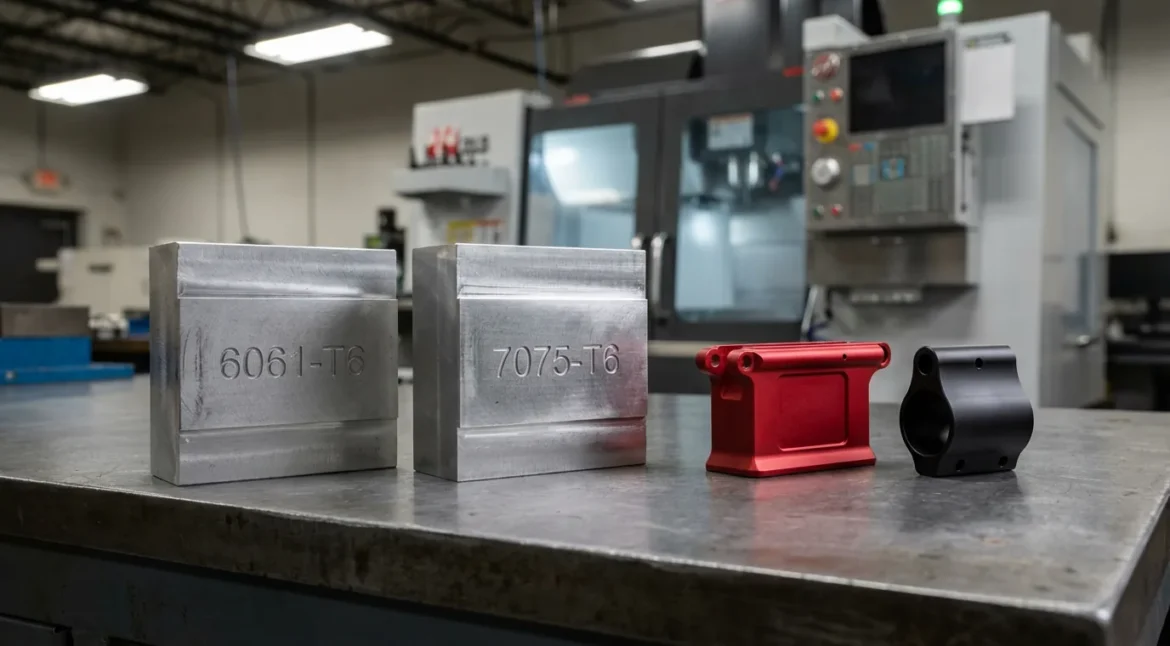
For anyone designing or manufacturing custom airsoft and rifle accessories, material selection is the very first decision you will face. While there are many metals available for CNC machining, two aluminum alloys dominate the tactical market: 6061-T6 and 7075-T6.
Both offer excellent strength-to-weight ratios and superior machinability compared to heavier metals, but they have distinct differences in performance, anodizing response, and cost. At Gran.my, we frequently receive drawings for custom magwells, gas blocks, slide plates, and charging handles. Understanding when to specify 6061 versus 7075 ensures your product meets its functional, aesthetic, and budget requirements.
This guide provides a technical comparison from a precision machining manufacturer’s perspective, helping you make informed decisions for your next CNC machined accessory project.
Understanding the Basics: What Do These Numbers Mean?
Before diving into performance comparisons, let’s look at what the 6000-series and 7000-series designations actually mean in aluminum alloy metallurgy.
6061 Aluminum (Aluminum-Magnesium-Silicon Alloy)
6061 is an aluminum alloy containing magnesium and silicon as its primary alloying elements. When heat-treated to the T6 temper, it achieves a good balance of strength, corrosion resistance, and excellent surface finishing capability.
Key Characteristics:
- Moderate to high strength (310 MPa tensile strength)
- Excellent corrosion resistance
- Outstanding response to Type II and Type III anodizing
- Highly machinable with consistent surface finishes
- Easy to weld and braze
- Cost-effective and widely available
7075 Aluminum (Aluminum-Zinc Alloy)
7075 is an aluminum alloy with zinc as its primary alloying element, along with smaller amounts of magnesium and copper. When heat-treated to T6, 7075 becomes one of the strongest commercially available aluminum alloys — often compared to many steels in terms of strength.
Key Characteristics:
- Very high strength (570 MPa tensile strength)
- Good fatigue resistance
- More difficult to machine than 6061
- Anodized finish may appear slightly duller or yellowish
- Poor weldability (not recommended for welded assemblies)
- Higher cost and less widely stocked
Mechanical Properties Comparison
Understanding the numbers behind these alloys is crucial when selecting the right material for precision tactical accessories.
| Property | 6061-T6 | 7075-T6 |
|---|---|---|
| Tensile Strength | 310 MPa | 570 MPa |
| Yield Strength | 276 MPa | 503 MPa |
| Elongation | 12-17% | 3-11% |
| Hardness (Brinell) | 95 HB | 150 HB |
| Fatigue Strength | 97 MPa | 159 MPa |
| Machinability Rating | 70% (Good) | 70% (Good) |
| Corrosion Resistance | Eccellente | Buono |
What These Numbers Mean for Accessory Design
For lightweight aesthetic parts (magwells, slide plates, thumb rests): 6061-T6 is more than adequate. These components don’t experience structural loads that would require the extreme strength of 7075. Using 6061 for these parts saves cost and produces a superior anodized finish.
For high-stress structural parts (buffer tubes, charging handles, barrel nuts): 7075-T6 is the better choice. These components are subjected to cyclic loading and impact forces. The nearly doubled tensile strength of 7075 provides the safety margin required for parts that must not fail under pressure.
CNC Machining Performance: Which is Easier to Machine?
From our experience machining thousands of accessory parts at Gran.my, the machining performance of these two alloys differs in subtle but important ways.
6061-T6: The Machinist’s Favorite
6061 is widely regarded as one of the easiest aluminum alloys to machine. It produces small, consistent chips that break away cleanly from the cutting tool, resulting in excellent surface finishes with minimal tool wear.
Why we love 6061 for accessory machining:
- Predictable cutting behavior allows for faster feed rates
- Produces smooth, burr-free edges on thin-walled magwells and slide plates
- Maintains tight tolerances (+/- 0.01mm) consistently across long production runs
- Lower tool wear translates to better per-part economics
7075-T6: Requires More Care
While still considered “machinable” compared to steels or titanium, 7075 requires more careful attention during CNC machining. Its higher hardness means higher cutting forces and more heat generation at the tool-chip interface.
Machining considerations for 7075:
- Requires sharper carbide tooling and potentially reduced cutting speeds
- More prone to work hardening, which can affect tight tolerance features like gas block bores
- Surface finishes may require additional deburring or secondary finishing operations
- Higher scrap rates during initial setup, especially for complex geometries
Anodizing Response: The Aesthetic Factor
For the tactical accessory market, appearance is often just as important as function. The way an alloy responds to anodizing determines the final color quality, uniformity, and durability of the part’s surface.
Type II Anodizing (Standard Decorative Finish)
6061-T6 is the undisputed king of color anodizing. It produces vibrant, consistent, and repeatable colors across production batches. This makes it the preferred choice for:
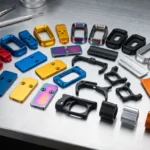
- Vibrant red, blue, gold, and rainbow anodized magwells
- High-contrast laser engraved logos (the raw aluminum beneath the anodized layer provides a sharp white-on-color contrast)
- Custom slide plates and thumb rests where aesthetic consistency matters
7075-T6 can be anodized, but the higher copper content in the alloy causes the anodized finish to appear slightly yellowish or muddy, especially in lighter colors like silver, gold, or rainbow. Dark colors (black, dark earth) work better, but even then, batch-to-batch color variation is more common with 7075.
Type III Anodizing (Hardcoat)
Type III anodizing creates a thicker, harder oxide layer (typically 0.0005″ to 0.002″ thick) that provides superior wear resistance and corrosion protection.
6061-T6 responds very well to Type III anodizing, producing a hard, durable matte black finish commonly used for:
- AR gas blocks and barrel adapters
- MLOK/Keymod rail covers and handguard accessories
- Charging handles that see heavy use
7075-T6 also performs well with Type III hardcoat, though the finish tends to be slightly less uniform. It is most often specified for functional black finishes on high-stress components.
Recommended Applications for Each Alloy
Based on our machining experience and the demands of the tactical and airsoft accessory market, here are our material recommendations by part category:
Parts Best Suited for 6061-T6
- Magwells (Hi-Capa, AR15, MLOK): Require excellent anodizing for color options, no structural load.
- Slide Plates (M&P, 1911): Thin-walled, aesthetic focus, benefit from clean machining and vibrant finishes.
- Trigger Guards and Thumb Rests: Moderate stress, high cosmetic requirements.
- Rail Accessories (MLOK/Keymod covers, QD end sets): Lightweight, anodized for uniformity.
- Magazine Base Plates and Extensions: Non-structural, need consistent color matching with other parts.
Parts Best Suited for 7075-T6
- Buffer Tubes: High cyclic stress, must withstand repeated compression.
- Charging Handles: Experience significant pulling force and should resist deformation.
- Barrel Nuts and Gas Block Mounting Hardware: Structural integrity under heat and pressure.
- Premium Upper Receivers (where weight matters but strength is non-negotiable).
Cost Considerations for OEM Production
When producing accessory parts in batch quantities, material cost and machining time both impact the final per-unit price.
Material Cost: 7075 aluminum is typically 20-40% more expensive than 6061 on a per-kilogram basis. This is due to its more complex alloying composition and lower production volumes.
Machining Cost: Because 7075 requires slower cutting speeds and more frequent tool changes, machining time can be 10-20% longer per part compared to 6061. Combined with the higher raw material cost, the total per-part cost for a 7075 component can be 30-50% higher than an equivalent 6061 part.
Recommendation: Unless your design requires the extreme strength of 7075, we recommend starting with 6061-T6 for the best combination of performance, aesthetics, and cost efficiency. Our team at Gran.my can help you evaluate your drawings and suggest the optimal material for your specific application.
How Gran.my Supports Your Accessory Manufacturing
At Gran.my, our Airsoft & Rifle Accessory Parts Machining service is built around the specific needs of OEM and ODM clients in the tactical and airsoft industry. When you partner with us, we provide:
- Material Consultation: We review your drawings and recommend the most appropriate aluminum grade, balancing strength, finish, and cost requirements.
- Precision CNC Machining: Our multi-axis CNC centers hold tight tolerances on complex geometries — from the intricate internal funnels of magwells to the precise bore dimensions of gas blocks.
- Surface Finishing Coordination: We manage Type II and Type III anodizing in your choice of color, along with laser engraving for logos, part numbers, and custom branding.
- Prototype to Production: Whether you need 10 prototype samples for fitment testing or a batch of 5,000 units for market launch, our processes scale seamlessly to meet your requirements.
- Quality Inspection: Every batch is verified against your CAD drawings using precision measuring tools, ensuring consistent fitment and appearance across all production runs.
Conclusione
Choosing between 6061 and 7075 aluminum for your airsoft or tactical accessory designs is not just about strength — it’s about matching the right material to the right application. For most aesthetic and lightweight components, 6061-T6 delivers excellent performance, beautiful anodizing results, and cost efficiency. For high-stress structural parts, 7075-T6 provides the strength and durability required for demanding environments.
Understanding these differences helps you design better products and communicate more effectively with your manufacturing partner.
Ready to manufacture your accessory designs? Share your drawings and material requirements with Gran.my for a comprehensive manufacturing review and competitive quotation.