CNC milling and CNC turning are both core processes for custom precision parts, but they solve different manufacturing problems. The right choice depends first on the part geometry, then on the material, tolerance, finish, quantity, and inspection requirements. A machining quote is more reliable when the design team understands which process is naturally suited to the features that matter most.
The simplest distinction is that turning is generally used to create rotational features from a workpiece that spins, while milling uses a rotating cutting tool to create features on a fixed or clamped workpiece. Real parts are often less simple than that description. A shaft may need milled flats, cross holes, or keyways after turning. A milled housing may need turned precision diameters or a bored feature. The best process can therefore be milling, turning, or a planned combination of both.
At Gran Industries, we review the drawing as a complete manufacturing problem before selecting the route. The goal is to use the process that supports the part function and production needs, rather than forcing every feature into one machine type.
When CNC turning is the natural choice
CNC turning is usually the practical starting point when the main geometry is cylindrical or rotational around a central axis. Typical turned features include outside diameters, bores, shoulders, grooves, threads, tapers, faces, and concentric steps. Shafts, bushings, spacers, threaded adapters, sleeves, and many bearing-related components are common examples.
Turning can be especially effective when the relationships between diameters and faces are central to the part function. With a stable setup and suitable workholding, the machining team can control coaxial features efficiently. For a component with close-fit journals, sealing diameters, or rotating interfaces, requirements such as asientos y orificios de los rodamientos should be evaluated together with the datum axis and inspection plan.
A turned part may still require secondary milling. Flats, wrench features, cross-drilled holes, keyways, mounting patterns, and off-axis details often need a milling operation or mill-turn capability after the rotational features are complete.
When CNC milling is the natural choice
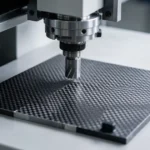
CNC milling is generally the better fit for prismatic, flat, multi-face, or contour-driven parts. Brackets, plates, enclosures, manifolds, fixtures, housings, and complex milled components often rely on pockets, slots, holes, planar faces, and features that are not rotationally symmetric. A rotating cutter moves through the programmed toolpath while the workpiece is held in a fixture or vice.
Milling is also well suited to parts that require features from several directions. Depending on the geometry, the process may use multiple 3-axis setups, indexed positioning, or a 5-axis route. The machining method should be chosen according to access and tolerance needs. Gran’s guide to when to use 5-axis CNC machining explains why additional machine motion is useful for some complex parts but not automatically necessary for all of them.
Start with the dominant geometry
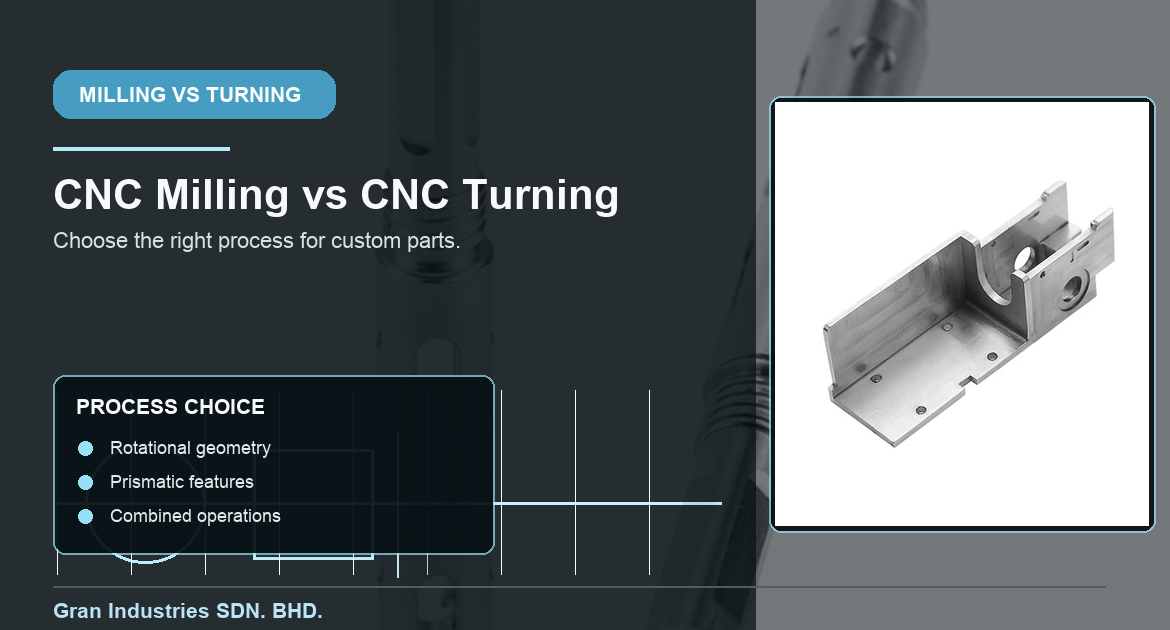
A practical way to choose between CNC milling and CNC turning is to identify the geometry that dominates the part. If most critical features are concentric diameters, axial faces, grooves, and bores, turning often provides the clearest starting point. If the main features are pockets, non-cylindrical profiles, hole patterns, planar faces, and contours, milling is usually more natural.
This does not mean that every feature must match the dominant process. The point is to avoid an inefficient route. Trying to make a predominantly turned part through several milling setups, or attempting to turn a component whose functional geometry is largely prismatic, can add handling, tooling, and inspection complexity without helping the finished part.
Material affects both processes, but does not decide alone
Material influences cutting speed, chip control, tool selection, heat management, workholding, and expected surface finish in both milling and turning. Aluminum, stainless steel, copper alloys, engineering plastics, and carbon-fiber composites each need a process strategy suited to their behavior. However, material alone does not determine whether a part should be milled or turned.
For example, an aluminum shaft may be a turning-led part because of its geometry, while an aluminum electronics enclosure is normally milling-led. A stainless steel sleeve may need turning for its diameters and milling for a mounting flat. Clear material specification and feature priorities let the manufacturing team select appropriate cutting tools and process parameters rather than relying on generic assumptions.
Tolerance and datum relationships drive the setup plan
Close tolerances are often more sensitive to setup and datum strategy than to the process name. A turning operation can hold related rotational features effectively when they are established from the relevant axis. A milling operation can control planes, locations, and hole patterns effectively when the part is located from stable datum features. Problems arise when the drawing does not show what the critical references are or when the process repeatedly breaks and re-establishes those references without a plan.
For a cylindrical part, consider whether runout, diameter, straightness, or face relationship is the actual functional requirement. For a prismatic component, identify the datum faces, hole positions, flatness, profile, and perpendicularity that drive assembly. The more precisely that intent is communicated, the more effectively the shop can choose a stable setup sequence.
Quantity changes the best manufacturing route
For a prototype, the preferred process may prioritize fast setup, flexible fixturing, and learning from the first article. For repeat production, the best route may justify dedicated workholding, tool-life planning, in-process checks, or a combined sequence that reduces handling time. Milling and turning can both support prototype and production work, but the balance of setup cost and cycle time changes with the quantity.
This is why a quote should include expected quantity or at least a realistic range. Gran’s article on Mecanizado CNC de prototipos frente a producción covers how this context affects tooling, inspection, and process decisions.
Surface finish and secondary operations should be planned early
The visible or functional surface of a part may require a controlled finish, deburring, coating preparation, anodizing, or another secondary operation. In turning, surface finish is linked to insert selection, nose radius, feed, workpiece stability, and the final pass. In milling, it is linked to cutter geometry, toolpath strategy, tool reach, engagement, and part rigidity. Neither process should be chosen on nominal dimensions alone when finish is important.
Specify the finish requirement where it matters and identify surfaces that must remain free of burrs, tool marks, or damage. Gran’s guide to surface finish before quotation and production provides useful context for describing that intent.
Many custom parts use both milling and turning
A combined route is common when a part needs both rotational accuracy and non-rotational features. Examples include a turned shaft with a keyway, a threaded adapter with a cross hole, a round housing with milled mounting faces, or a precision bushing with a flat and tapped pattern. The process may use separate machines or a mill-turn setup, depending on the part and production volume.
In these cases, the key consideration is how the part will be transferred and referenced between operations. Datum features, workholding, and inspection should be planned so the critical relationships are maintained. This is more useful than treating the project as a simple choice between two labels.
Frequently asked questions about CNC milling vs CNC turning
Is CNC turning cheaper than CNC milling?
Not always. Turning can be efficient for rotational geometry, while milling can be efficient for prismatic and multi-face geometry. Cost depends on the complete process: material, setups, tooling, tolerance, finish, quantity, and inspection.
Can one part need both CNC milling and CNC turning?
Yes. Many custom parts combine diameters, bores, threads, or grooves with flats, holes, keyways, pockets, or mounting patterns. A combined process may be the most practical route.
Which process is better for tight tolerances?
Neither process is universally better. The important factors are whether the feature suits the process, how the part is located, the machine and tooling condition, material behavior, and the inspection method.
What should I send for a milling or turning quote?
Send a 3D model and 2D drawing when available, along with material, quantity, finish requirements, critical dimensions, datum information, and any inspection expectations. This lets the machining team determine whether milling, turning, or a combined route is appropriate.
Choose the process that fits the functional features
CNC milling and CNC turning are complementary processes. Turning is often the natural route for rotational features, while milling is often the natural route for prismatic, multi-face, and contour-driven features. A combined plan is frequently the right answer for custom parts that include both.
For further technical background, Sandvik Coromant provides accessible references on fresado y turning fundamentals. If you are preparing a custom part for quotation, send Gran your drawing and project details so we can review the most practical process.