In precision manufacturing, machining alone is only part of the process. Quality control is what confirms that each finished component matches the required dimensions, tolerances, and functional expectations. For businesses that depend on custom parts, reliable inspection helps reduce errors, improve consistency, and support stable production results.
In CNC machining, even a well-programmed process must be supported by proper verification. This is especially important when parts are used in demanding industrial applications where fit, repeatability, and surface quality all matter. A strong quality control process helps ensure that every stage of manufacturing contributes to a dependable final part.
Quality Control Supports Precision and Consistency
One of the main advantages of CNC machining is its ability to produce highly accurate parts with repeatable results. However, repeatability must be checked throughout the process. Inspection helps verify that the machined part remains within specification and that production quality is maintained from the first part to the last.
This is particularly valuable for prototype development, low-volume custom work, and larger production runs. When measurements are verified consistently, manufacturers can identify variation early and maintain tighter control over the final outcome.
Inspection Methods Used in Precision Manufacturing
Quality control in CNC machining often includes dimensional measurement, visual inspection, and verification of critical features. Depending on the complexity of the part, manufacturers may use precision measurement equipment to confirm hole positions, surface dimensions, and overall part geometry.
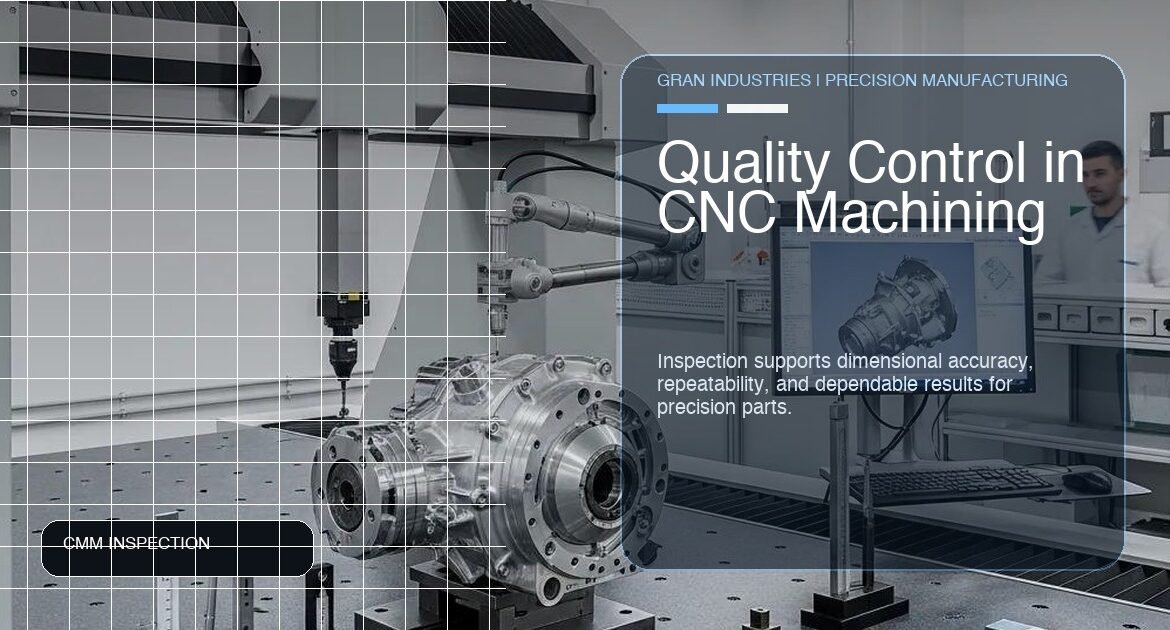
Coordinate Measuring Machine (CMM) inspection is especially useful for precision components because it allows detailed measurement of complex part features. This helps manufacturers confirm whether a machined component aligns with design requirements before it moves to assembly or delivery.
Why It Matters for Custom Parts
Custom machined parts are often produced for specific performance requirements. Unlike standard off-the-shelf items, these parts may need to match unique dimensions, materials, and application needs. Quality control helps ensure that those custom requirements are translated accurately into the finished component.
Whether the material is aluminium, stainless steel, copper, fibra de carbono, or another engineering material, inspection plays an important role in confirming that the machining process has produced the intended result. This is one reason quality assurance remains central to custom part manufacturing.
Supporting the Transition from Prototype to Production
Quality control also supports a smoother transition from prototype work to repeat production. During prototyping, inspection helps confirm that the initial design can be manufactured accurately. During production, the same focus on verification helps maintain consistency across multiple units.
This connection between machining and inspection is important for customers who need both flexibility and reliability. By combining CNC precision with structured quality control, manufacturers can better support projects that require dependable part performance over time.
A Practical Standard for Better Manufacturing Outcomes
For any business sourcing precision components, quality control should not be treated as an afterthought. It is a practical part of the manufacturing process that supports accuracy, reduces uncertainty, and improves confidence in the finished product.
In CNC machining, strong inspection practices help turn digital designs into parts that are not only precisely machined, but also properly verified. That combination is essential for achieving reliable results in modern precision manufacturing.
Related Pages for the Next Step
These internal links help connect quality control with review, production planning, and broader process guidance.