AI box hardware often looks simple from the outside, but the enclosure and custom machined parts around it usually carry tight practical requirements. Mounting positions, connector openings, heat flow, service access, and finish quality all affect whether the final device is easy to build and reliable in use.
That means an RFQ for an AI box enclosure should do more than attach a 3D model and ask for a machining price. The supplier needs enough information to understand how the enclosure works, which surfaces are functional, which tolerances matter, and where the design can still be adjusted for manufacturability.
At Gran Industries, this kind of project is usually reviewed as a mix of enclosure machining, mounting-interface control, drawing review, and surface-finish planning rather than as a generic box-shaped part. A better RFQ reduces quoting noise early and helps the supplier match process choice to the real product requirement.
Start by explaining what the AI box must support
Some AI boxes are small edge-computing housings. Others are controller enclosures, sensor-processing modules, gateway boxes, or compact industrial compute assemblies. The supplier does not need the full product roadmap, but they do need enough context to understand what the mechanical structure is protecting and how the box will be used.
Useful starting points include:
- Whether the enclosure is for indoor, outdoor, mobile, or factory use
- Whether the box carries a PCB, heat sink, fan, connector plate, or display opening
- Whether the enclosure is a prototype shell, pilot build, or repeat production part
- Whether appearance, sealing, EMI, or heat transfer is the higher priority
- Whether the supplier is only machining the housing or also supporting related custom brackets and covers
Material choice should match heat, weight, and finish intent
Many AI box housings begin as aluminum because it balances weight, stiffness, corrosion performance, and machining practicality. Some projects move toward stainless steel for harsher environments or engineering plastics where insulation, lower weight, or reduced cosmetic cost matters more.
When material is still open, it helps to say so directly. If aluminum is likely, the RFQ can point the supplier toward Pemprosesan CNC aloi aluminium. If corrosion, washdown, or structural exposure is the concern, pembuatan CNC keluli tahan karat may be the better fit. If a cover, carrier, or insulator is nonmetallic, pembuatan plastik kejuruteraan may also belong in the review.
Connector openings and interface faces need more than nominal sizes
AI boxes often include USB, Ethernet, power, antenna, display, or sensor cutouts. The mistake is to treat those as simple window dimensions when they actually interact with connector shells, panel hardware, cable bend room, and assembly sequence.
A stronger RFQ identifies:
- Which openings are cosmetic and which are interface-critical
- Whether the connector is board-mounted, panel-mounted, or bracket-mounted
- Whether screw locations, datum faces, or opening positions must align to a PCB or purchased component
- Whether edge quality matters for gaskets, labels, or visible customer-facing surfaces
This is where good enclosure RFQs often overlap with precision-hole planning, threaded-hole specification, dan locator-face control.
Thermal features should be called out as functional geometry
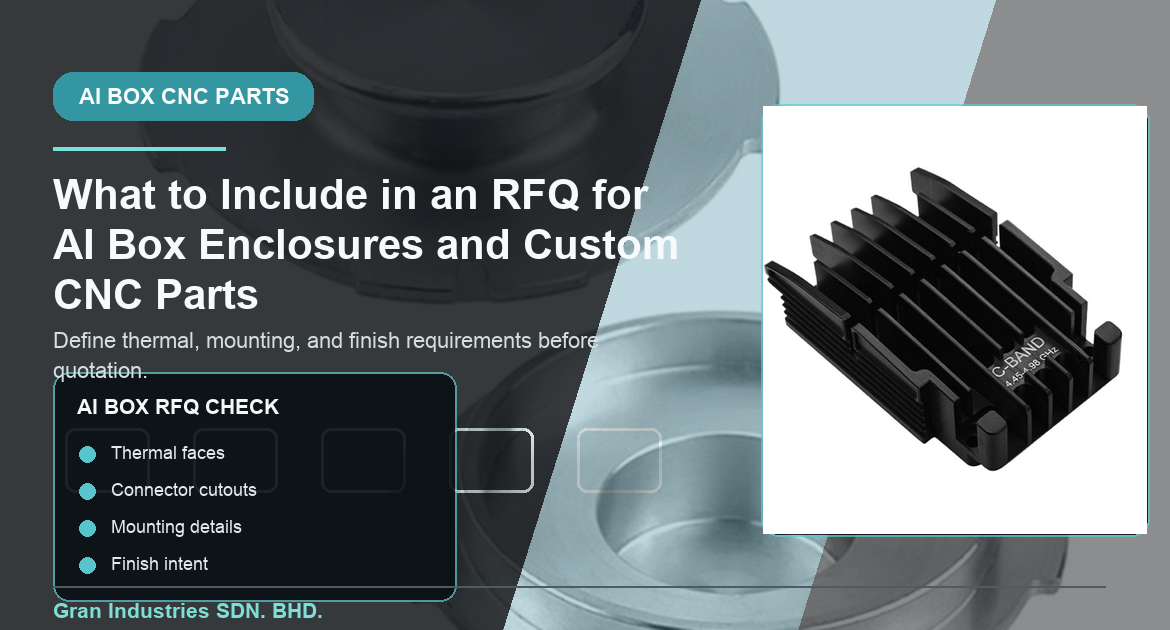
If the enclosure helps move heat away from processors, power electronics, or internal modules, that function should be visible in the RFQ. Machined fins, heat-spreader contact areas, fan mounting faces, and thermal-pad contact zones are not just extra details. They may control the machining strategy and inspection priority.
Useful thermal notes include:
- Whether a face must stay flat for heat-sink contact
- Whether internal pockets or ribs are for airflow or clearance
- Whether the housing needs wall-thickness limits around hot zones
- Whether coatings or anodizing could affect thermal contact or electrical behavior
These requirements connect naturally to perancangan mendalam poket, thin-wall control, dan surface-finish specification.
Mounting strategy should be visible before quoting
Most AI box projects include more than one part: enclosure halves, covers, mounting plates, standoffs, brackets, or clamp features. If the RFQ only shows isolated solids, the supplier may quote the pieces individually without seeing where alignment and stack-up risk actually sit.
The RFQ gets stronger when it shows:
- How the PCB or subassembly sits inside the box
- Which faces locate covers, heat sinks, or front panels
- Which threads are opened often for service and which are one-time assembly points
- Whether the enclosure must mount to DIN rails, walls, brackets, or machine frames
That context helps the supplier evaluate shoulder faces, standoff heights, screw access, and part-to-part fit before production starts.
Finish and cosmetic standards should be separated from function
AI box housings often mix functional surfaces with visible customer-facing faces. A common RFQ problem is to apply the same finish expectation everywhere without distinguishing contact surfaces, sealing edges, internal pockets, and cosmetic exteriors.
It is better to state:
- Which faces are visible after assembly
- Whether bead blasting, anodizing, brushing, painting, or powder coating is expected
- Whether logos, labels, engraving, or color consistency matter
- Whether internal tool marks are acceptable where they do not affect fit or thermal contact
This avoids mixing appearance requirements into the wrong tolerance discussion and keeps the quote closer to the real product need.
Prototype and production intent should not be hidden
A prototype AI box may prioritize speed and fit-checking. A production enclosure may prioritize repeatability, finish consistency, and fixture-based inspection. If the RFQ does not separate those stages, the supplier may quote one phase in a way that does not fit the next.
Before release, it helps to clarify:
- Prototype quantity
- Pilot-build quantity
- Expected production volume or annual forecast
- Whether design revisions are still likely after the first build
That information can change process suggestions, inspection planning, and which enclosure details deserve tighter control on the first run.
What to include in the RFQ package
For AI box enclosures and related custom CNC parts, the RFQ is usually stronger when it includes:
- Lakaran 2D dan model 3D apabila tersedia
- Assembly view or PCB reference layout for interface-critical features
- Material target or open material options
- Thermal-contact, wall-thickness, and finish notes
- Critical holes, threads, datum faces, and connector openings
- Prototype, pilot, and production quantity split
- Inspection expectations for fit, finish, and assembly-sensitive features
- Clear contact point for DFM questions during quoting
A better AI box RFQ leads to better enclosure decisions
An AI box enclosure may be machined from familiar materials, but the quoting quality depends on how clearly the RFQ describes heat, interface geometry, finish expectations, and assembly intent. When that information is visible early, the supplier can review the project as a functional enclosure instead of a generic machined shell.
If you are sourcing an AI box housing, controller enclosure, mounting plate, or related custom machined parts, Gran Industries can review the drawings and production intent before quotation. You can also Hantarkan butiran projek anda untuk semakan. Apabila anda sudah bersedia.